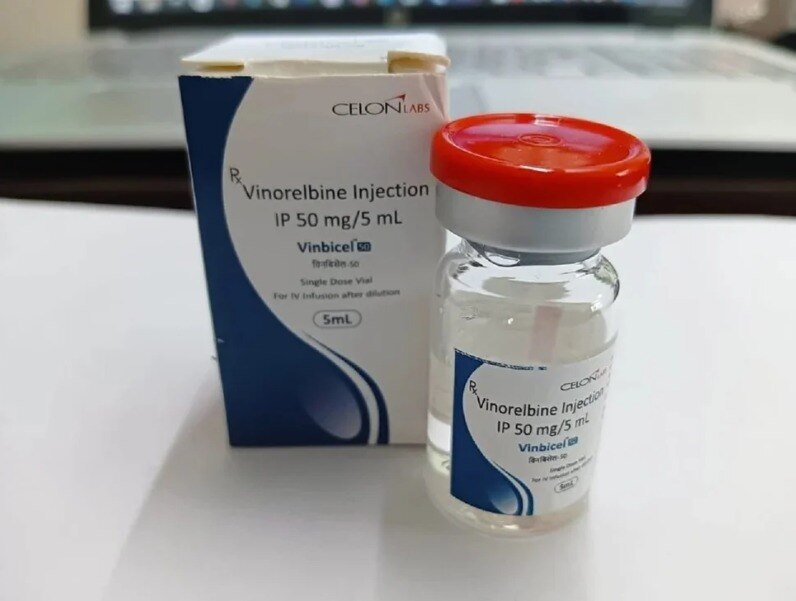
The 50 mg printed on a vinorelbine vial is usually the total drug content, not a standard patient dose, and the product often arrives as a concentrate that requires controlled dilution. By checking the formulation, clinical label, safety controls, cold-chain evidence and export dossier, you can compare suppliers and choose a procurement route that your destination market can actually accept.
Key takeaways
- Treat 50 mg as total vial content, not an individual patient dose.
- Confirm concentration, fill volume, batch COA, expiry date and destination-market label.
- Check blood counts, liver function, interactions and administration requirements before each dose.
- Document temperature excursions and quarantine affected stock until quality review is complete.
What does “vinorelbine 50 mg” mean on the vial?
“Vinorelbine 50 mg” normally states the total amount of vinorelbine in the vial, not a universal patient dose, concentration or post-dilution strength. A common presentation is a 10 mg/mL concentrate: a 5 mL vial contains 50 mg. Confirm the actual nominal fill volume and concentration on the vial label and batch-specific certificate of analysis.
| Presentation | What it means | What you must confirm |
|---|---|---|
| Ready-to-use solution | The supplied liquid is intended for administration without further dilution | Route, final volume and infusion instructions |
| Concentrate for dilution | The vial contains liquid medicine that must be diluted before infusion | Permitted diluent, dilution volume, final concentration and stability |
| Powder for reconstitution | The vial requires a specified solvent before dilution or administration | Reconstitution solvent, volume, concentration and handling sequence |
Ask the vinorelbine 50 mg supplier: What is the nominal fill volume? Is concentration stated in mg/mL? Which diluent is permitted? What dilution volume and final concentration are authorised? Is the vial single-use?
Do not compare suppliers on vial strength alone. The registered formulation, overfill, container closure and preparation instructions determine whether two 50 mg presentations are interchangeable. Use the supplied package insert to verify whether 0.9% sodium chloride or 5% dextrose is permitted, along with the authorised final volume, infusion duration and post-dilution stability.
Which patients and regimens does the destination-market label permit?
A 50 mg vial does not authorise a 50 mg patient dose. The destination-market label determines whether vinorelbine is indicated for non-small-cell lung cancer and, in some jurisdictions, breast cancer; it also defines treatment lines, monotherapy, and combination regimens.
| Label or regimen source | Dose expression | Buyer’s required check |
|---|---|---|
| U.S. labelling | Commonly 30 mg/m² intravenously once weekly | Confirm the authorised indication and regimen |
| Other product information | 25–30 mg/m², depending on regimen | Match the exact monotherapy or combination schedule |
| Destination-country label | The legally applicable indication and instructions | Do not substitute a foreign label or commercial listing |
Adult dosing is calculated from body-surface area, not selected from the vial strength. An anti cancer injection distributor must compare the destination country’s approved label with the proposed indication, dose, frequency, dilution instructions, and combination treatment before ordering.
Vinorelbine is intravenous only. Accidental intrathecal administration of a vinca alkaloid is a potentially fatal medication error, so procurement specifications must require:
- Prominent “for intravenous use only” wording on the vial, carton, and shipping pack
- Tamper-evident packaging and documented closure controls
- A package insert in the destination country’s required language
- Route, preparation, and administration instructions that match the approved product
A vinorelbine injection exporter therefore has a clinical-documentation obligation: supply the authorised prescribing information, not merely a strength, product name, or marketing claim.
What must the oncology team check before each administration?
Before every dose, the oncology team must confirm the patient’s complete blood count, absolute neutrophil count, platelet count and liver-function assessment. If counts fall below the product label’s thresholds, withhold or modify treatment only as that approved label and regimen specify; there is no universal cutoff for every presentation.
Check these administration controls before the infusion starts:
| Control | What to verify | Why it matters |
|---|---|---|
| Route | Intravenous route only; never intrathecal | Accidental intrathecal vinca-alkaloid administration can be fatal |
| Patient and dose | Identity, body-surface-area calculation and prescribed regimen | A 50 mg vial is not a universal patient dose |
| Product | Vial integrity, batch details and expiry | A damaged seal, leak or visible particles require quarantine |
| Preparation | Approved diluent, dilution volume and final concentration | An incorrect dilution can cause dosing or stability failure |
The team must assess neutropenia, infection, thrombocytopenia, hepatic impairment, peripheral neuropathy, constipation or ileus, and extravasation risk. Check pregnancy status and fetal-harm warnings, then review the supplied product information for interacting medicines and regimen-specific precautions. Administration requires oncology supervision, not routine injection handling.
Preparation, administration, spill response and disposal require hazardous-cytotoxic procedures, including worker protection. USP <800> provides a reference for U.S.-linked supply chains, but it does not replace national law. A procurement search for “vinorelbine 50 mg for pharmaceutical exporter” must therefore end with the approved label and a site-ready safety protocol.
How should distributors handle cold-chain failures and product incidents?
A refrigerated-shipping promise is insufficient for vinorelbine procurement options: it does not prove that unopened vials stayed within 2–8°C, avoided freezing, or remained protected from light. Require shipping-lane qualification, calibrated temperature-monitor records, excursion-reporting procedures, quarantine instructions, documented disposition rules, and evidence that the final pack protects the vial from light and breakage.
The buyer must compare any excursion with the exact manufacturer’s stability data, including permitted out-of-refrigeration time and freezing exposure. Do not apply another product’s limits. Record the batch number, vial quantity, shipment identifier, logger serial number, temperature trace, dates, photographs, and every decision.
Use this incident checklist:
- Missed dose or delayed treatment: alert the treating team and obtain written clinical direction; do not create a replacement or release rule.
- Suspected extravasation: follow the treating facility’s cytotoxic-extravasation protocol and document the patient, vial, batch and response.
- Temperature excursion: quarantine the affected stock pending the manufacturer’s written assessment.
- Damaged vial or broken seal: quarantine it and obtain direction from the responsible pharmacist or manufacturer.
- Visible particles or discoloration: do not use or release the vial; retain evidence and seek written direction.
The package insert, manufacturer, pharmacist, responsible person or treating team must determine whether product can be used, returned, destroyed or replaced. A traceable shipment and decision record protects patients and prevents an undocumented incident from becoming an unsafe release.
Which exporter and procurement route fits your destination market?
A finished-product purchase is usually the simplest route, but it does not transfer registration rights. Compare these vinorelbine procurement options before choosing a vinorelbine 50 mg supplier:
| Route | Registration ownership | Pharmacovigilance and artwork | MOQ, batch release and market changes |
|---|---|---|---|
| Finished product | Local importer or marketing-authorisation holder | Importer/MAH owns local safety reporting and approved artwork | Lower MOQ; exporter releases manufacturing batches; changing countries needs new approval |
| Dossier licensing or local MA arrangement | Named local MAH controls the authorisation | Local MAH controls artwork and pharmacovigilance; agreement allocates data rights | Higher setup cost; local release duties apply; market changes require regulatory variation or a new filing |
| Contract manufacture or private label | Buyer or brand owner owns the product authorisation | Buyer controls brand artwork and pharmacovigilance; manufacturer follows the approved file | MOQ is usually higher; both parties document batch release; changing market can require new artwork, specifications or registration |
Ask for a manufacturing authorisation, current GMP evidence, product specification, batch-specific certificate of analysis, stability data, packaging details, batch-release records and a Certificate of Pharmaceutical Product where the authority accepts it.
Indian GMP compliance does not authorise sale everywhere. Confirm destination-country registration, import permits, pharmacovigilance arrangements and any legalisation or apostille requirement. NIBA HEALTHCARE is one supplier to question against this file, not proof of market authorisation.
Buy only when the exporter can supply the exact 50 mg presentation, formulation, artwork and documents registered in your intended country.
Related product
 | Anti Cancer Injection minimum order quantity 10 Vial Strength 50 mg Form Injection Usage/Application Clinic Composition Vinorelbine injection 50 mg Storage Condition Store... View product → |
Frequently asked questions
What does “vinorelbine 50 mg” mean on the vial?
It normally identifies 50 mg of total vinorelbine in the vial. A 10 mg/mL, 5 mL presentation is one common format, but you must confirm the printed concentration and nominal fill volume on the vial and batch-specific certificate of analysis.
Which patients and regimens does the destination-market label permit?
Use the approved label in the importing country to confirm indications, age limits, contraindications, dosing schedules and combination therapies. Do not substitute another country’s label or treat the 50 mg vial size as a patient dose.
What must the oncology team check before each administration?
Check the patient’s blood counts, liver function, current medicines, treatment schedule, dose calculation, route, dilution instructions and venous access. Follow the destination-market product information and local oncology protocol.
How should distributors handle cold-chain failures and product incidents?
Quarantine stock after a temperature excursion, preserve logger records and packaging, record the batch and shipment details, and request a documented quality assessment before release. Report suspected defects through the supplier’s pharmacovigilance or quality channel.
Which exporter and procurement route fits your destination market?
Choose a vinorelbine injection exporter that can provide the required manufacturing, quality, shipping and regulatory documents for your market. Compare direct procurement with an authorised local distributor based on registration status, import responsibility, lead time and cold-chain control.