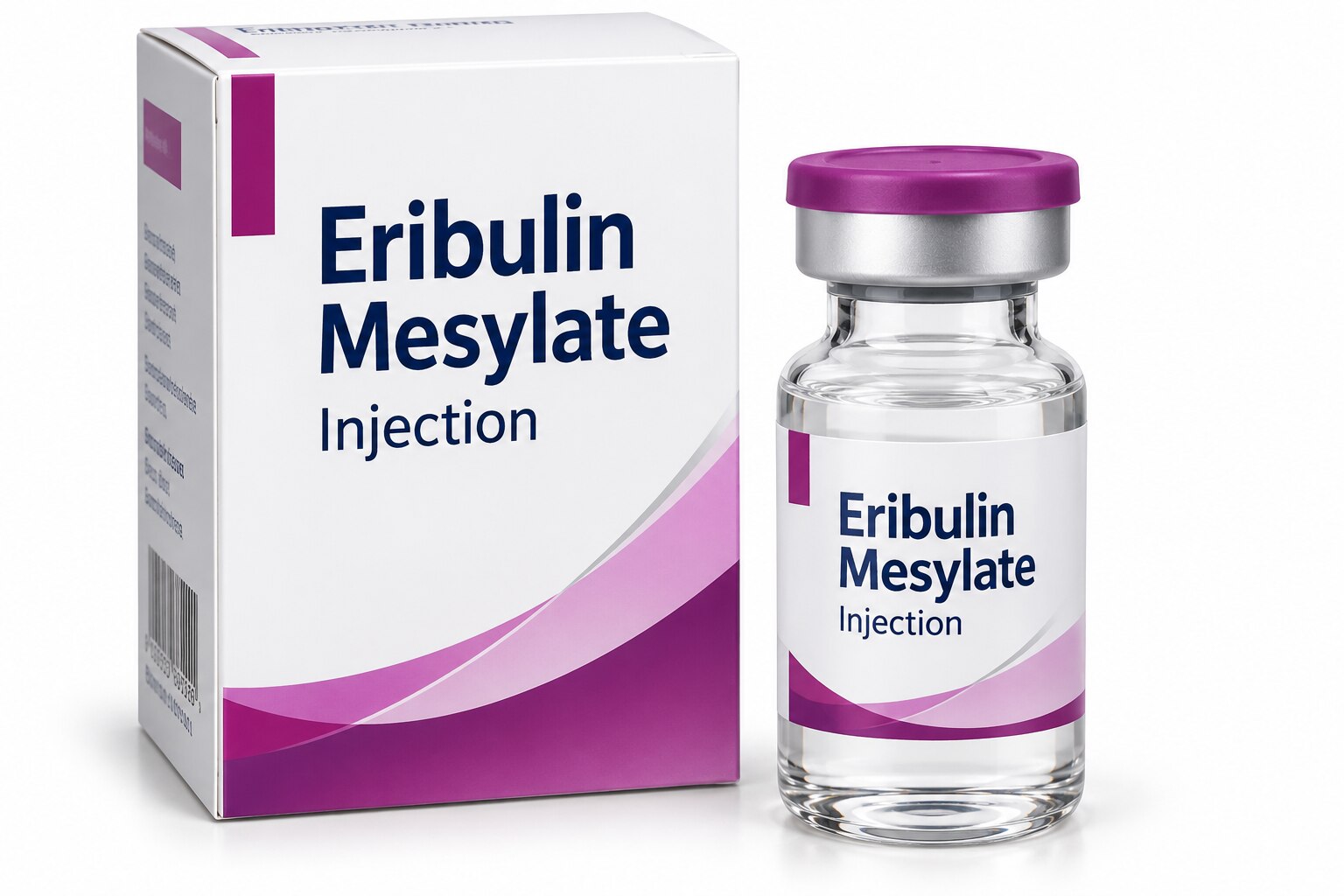
Eribulin mesylate is a cytotoxic intravenous medicine used in defined treatment settings, not a general substitute for every oncology injection. By the end, hospital buyers can check whether the medicine fits the prescribed protocol, calculate procurement needs, qualify an eribulin mesylate injection supplier, and control receipt, preparation, and continuity risks.
Key takeaways
- Confirm the approved indication, regimen, renal function and hepatic function before ordering.
- Calculate the dose from body-surface area and verify vial strength, volume and expiry.
- Request batch records, certificates of analysis and Chilean regulatory documentation from suppliers.
- Inspect temperature records, packaging integrity and batch details when each shipment arrives.
When eribulin is the right oncology medicine
Eribulin mesylate is a cytotoxic medicine that disrupts microtubules, the structures that move chromosomes during cell division. By binding to tubulin and blocking microtubule growth, it produces mitotic arrest and can stop susceptible tumour cells from multiplying. An eribulin injection for hospitals is a ready-to-use intravenous oncology medicine, not a self-administered treatment.
| Approved setting | Treatment history required | Procurement rationale |
|---|---|---|
| Metastatic breast cancer | At least two prior chemotherapy regimens, including an anthracycline and a taxane | Supports use when the oncologist’s protocol places eribulin after those therapies |
| Unresectable or metastatic liposarcoma | Prior anthracycline-containing therapy | Supports use when surgery is not possible or disease has spread |
| Other cancer or treatment line | Not covered by these approved settings | Requires separate institutional and clinical justification for off-label use |
The usual reference schedule for these principal indications is 1.4 mg/m² intravenously over 2–5 minutes on days 1 and 8 of a 21-day cycle. It is a reference-label schedule, not an individual treatment recommendation; the oncologist’s prescription and the Chilean registered product information control the order.
Do not substitute eribulin for vinorelbine, vincristine, or a taxane regimen because all are injectable anticancer medicines. Their indications, treatment lines, microtubule effects, administration, monitoring, and protocol positions differ. A hospital considering off-label eribulin use needs documented clinical reasoning and institutional approval.
How pharmacy calculates and prepares each dose
Pharmacy does not infer a patient dose from a catalogue concentration. It confirms the body-surface area (BSA), oncologist’s prescribed dose, dose reductions, renal or hepatic adjustments, and whether the local label expresses strength as eribulin or eribulin mesylate.
A listing for eribulin mesylate injection for pharmaceutical supplier in santiago is a sourcing lead, not a dosing instruction.
The calculation workflow is:
- Multiply BSA by the prescribed dose in mg/m² to obtain total milligrams. For example, 1.8 m² × 1.4 mg/m² = 2.52 mg.
- Check the registered Chilean presentation. Using 0.44 mg/mL and a 2 mL vial for arithmetic only, 2.52 mg ÷ 0.44 mg/mL = 5.73 mL.
- Divide by 2 mL and round up: three vials are required. Record residual volume, single-dose-vial wastage, and preparation losses.
- Do not convert between eribulin and eribulin mesylate unless the registered label states the equivalence.
| Input | Pharmacy action | Result |
|---|---|---|
| BSA and prescribed mg/m² | Confirm the order and calculate | Patient-specific milligrams |
| Renal or hepatic impairment | Apply the approved dose-modification table | Reduced starting dose when indicated |
| Vial concentration and volume | Convert milligrams to millilitres and whole vials | Safe withdrawal plan |
In a biological safety cabinet, trained staff aseptically withdraw the solution, inspect it for particles or discoloration, and prepare the approved syringe or infusion bag. Label the final container with patient, drug, dose, concentration, diluent, preparation time, expiry, and handling warnings. Oncology staff administer it intravenously, then dispose of equipment and residue as cytotoxic waste.
Follow the Chilean product information if its dilution, stability, container, or administration instructions differ.
Which patient and protocol checks must happen before treatment
Before pharmacy schedules a dose or releases a purchase, the oncology team must confirm the diagnosis, treatment line, formulary position, and prior therapy. Reference indications include metastatic breast cancer after at least two chemotherapy regimens containing an anthracycline and a taxane, and unresectable or metastatic liposarcoma after anthracycline-containing treatment.
| Check | Finding that changes the order | Procurement or scheduling consequence |
|---|---|---|
| Blood counts | ANC below 1,000/mm³ or platelets below 75,000/mm³ | Withhold treatment; apply the reference label’s delay or dose-reduction table |
| Kidney function | Creatinine clearance 30–50 mL/min | Starting dose changes from 1.4 to 1.1 mg/m² |
| Liver function | Child-Pugh B hepatic impairment | Starting dose changes to 1.1 mg/m² |
| Cardiac risk | Congenital long-QT syndrome, heart failure, bradyarrhythmia, electrolyte abnormality, or QT-prolonging medicine | Reconsider treatment; obtain ECG and correct electrolytes when indicated |
Check blood counts before every dose because neutropenia is dose-limiting and febrile neutropenia can disrupt admission planning, monitoring, and cycle timing. Review baseline and treatment-related peripheral neuropathy before approving the order.
Vinorelbine, vincristine, and taxane regimens require separate indication, dose, administration, storage, and monitoring decisions. Procurement staff must not substitute them for eribulin or approve a purchase that conflicts with the oncologist’s protocol. Eribulin is a hazardous antineoplastic, so receiving, preparation, administration, spill response, and waste procedures must follow the hospital’s hazardous-drug controls.
How to qualify an eribulin supplier in Santiago before purchase
Do not approve an eribulin mesylate injection supplier from a quotation or GMP certificate alone. Verify the exact manufacturer, manufacturing site, approved concentration and vial presentation, registered importer or marketing holder, and product registration through the Instituto de Salud Pública de Chile (ISP).
The vial label, Spanish product information, and registration record must describe the same product.
Request this qualification file before issuing a purchase order:
- Commercial invoice, packing list, certificate of origin, import documentation, and the supplied batch’s certificate of analysis.
- Lot number, expiry date, approved Spanish-language product information, and shipping-temperature evidence when applicable.
- Written confirmation of local stock or import lead time, a minimum order of 10 vials, hospital delivery, quotation validity, and available batch expiry.
- Pharmacovigilance contact, recall communication procedure, batch traceability, replacement terms for damaged goods, and evidence of current inventory.
| Check | Acceptable evidence | Failure risk |
|---|---|---|
| Exact product identity | ISP record matches manufacturer, site, strength, volume, and holder | Unregistered or non-equivalent medicine |
| Batch release | Certificate of analysis matches vial lot and expiry | Unverifiable quality or expired stock |
| Logistics | Inventory proof or documented import timeline and temperature records | Treatment delays or uncontrolled transport |
When assessing NIBA HEALTHCARE as an eribulin mesylate pharmaceutical distributor, ask for this batch-level file rather than relying on a general anti cancer injection supplier in Santiago listing. The same rule applies to any eribulin mesylate pharmaceutical distributor: a GMP certificate proves neither Chilean authorization nor current inventory.
Related product
 | Anti Cancer Injection Minimum order quanity 10 Vial Strength 0.44 mg/ml Packaging Type Vial Packaging Size 2 ml Vial STORAGE CONDITION Store below 30 Degree C Country of... View product → |
How receiving and continuity controls protect the chemotherapy supply
A shipment stays in quarantine until pharmacy confirms that it matches the purchase order and the registered Chilean product. Receiving eribulin is a clinical-control step, not a count of boxes.
- Compare the active ingredient, concentration, vial volume, quantity, batch number and expiry date with the order and accompanying documents. Match the batch and expiry details on every vial to its carton.
- Inspect each vial for an intact seal, clear solution, damage, cracks, leakage, particles or discoloration. Record discrepancies and do not release affected stock.
- Check the supplier’s written storage instructions: the registered temperature range, protection from light, controlled-ambient transport requirement, temperature records, excursion procedure, minimum remaining shelf life at delivery and the quarantine decision after a deviation. “Below 30 °C” alone answers none of these questions.
- Receive eribulin as a hazardous drug under the hospital’s procedures for protective equipment, spill response, segregation and cytotoxic waste. Ordinary injectable handling is not enough.
The delivered price excludes pharmacy validation, import clearance, temperature-controlled transport, hazardous-drug receiving, compounding capacity, discarded residual volume, expiry management and emergency replacement. A cheaper vial can become the costlier supply if a shipment arrives short-dated or damaged.
Plan continuity across forecasted treatment cycles: hold defined safety stock, record batch use against each patient and retain documents for a recall. Agree in writing how quickly replacement stock arrives and who authorises it. If supply fails, use the documented clinical fallback; never treat another injectable oncology medicine as an automatic substitute.
Frequently asked questions
When is eribulin the right oncology medicine?
Use eribulin only for an approved indication and treatment protocol, after the oncology team reviews prior therapy, performance status, blood counts, renal function and hepatic function.
How does pharmacy calculate and prepare an eribulin dose?
Pharmacy calculates the prescribed dose from body-surface area, checks the vial concentration and expiry, and prepares the intravenous dose under the hospital’s hazardous-drug procedures.
Which checks must happen before eribulin treatment?
Confirm the patient identity, diagnosis, treatment day, dose, blood counts, organ function, allergies, prior toxicity and the oncologist’s order before administration.
How do you qualify an eribulin supplier in Santiago?
Review the supplier’s legal identity, Chilean regulatory documentation, product registration or import basis, GMP evidence, batch certificate, storage controls and supply continuity plan.
What should hospitals check when receiving eribulin?
Match the delivery against the purchase order, inspect seals and vials, verify batch and expiry details, review transport temperature records and quarantine damaged or discrepant stock.