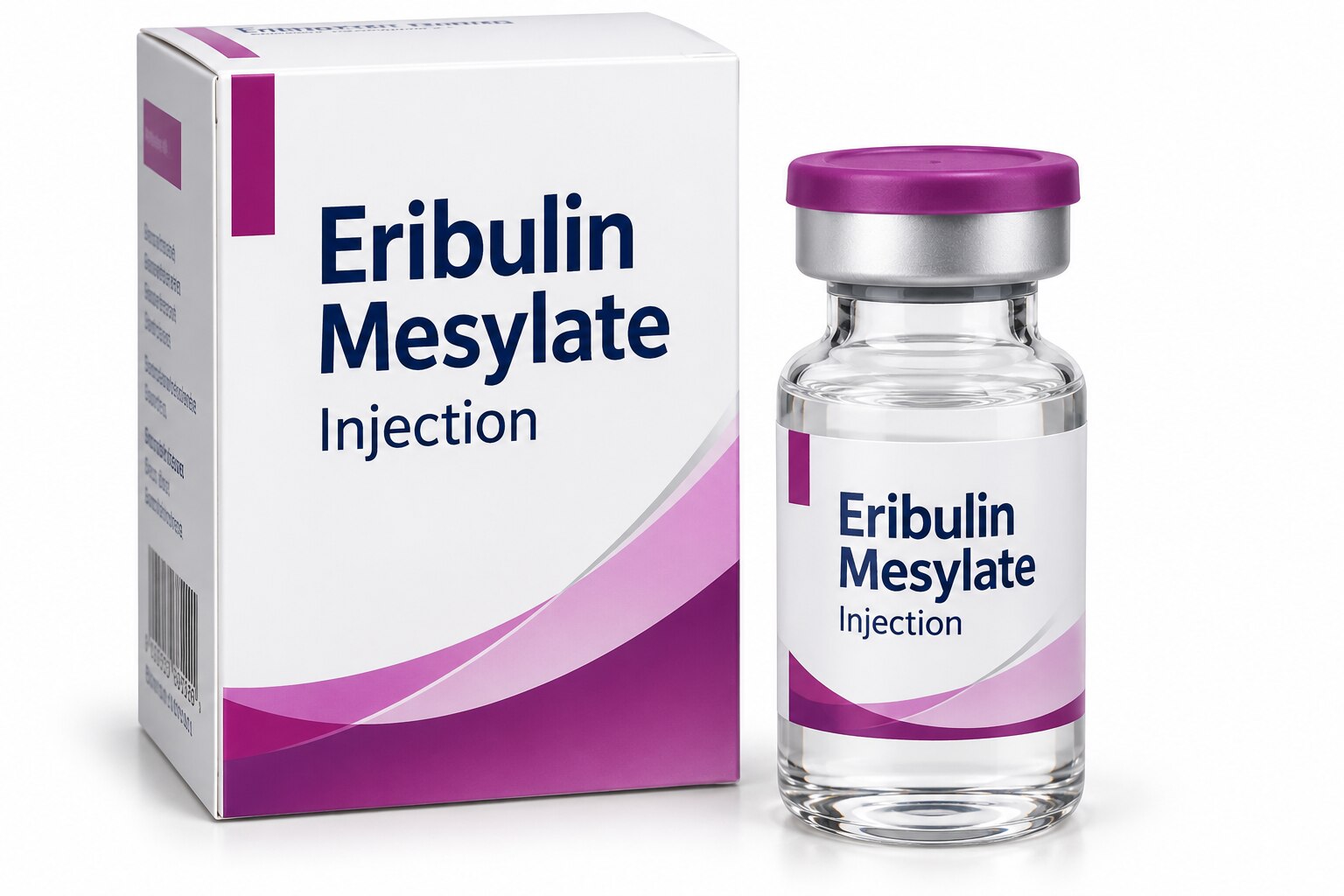
A safe eribulin purchase depends on more than finding a vial and a quoted price: the indication, dose basis, label strength, temperature control, cytotoxic handling and Chilean authorization must all align. By the end, a Santiago procurement team will have a practical checklist for evaluating the product, exporter, shipment and importer-of-record before issuing a purchase order.
Key takeaways
- Match 1.4 mg/m² dosing with the vial concentration and prescribed volume.
- Verify aseptic preparation, cytotoxic handling and transport temperature records.
- Confirm Chilean ISP authorization, import paperwork and product registration before ordering.
- Compare exporters on batch traceability, remaining shelf life and delivery controls.
When is eribulin mesylate clinically appropriate, and how is it dosed?
Eribulin mesylate matches a labeled oncology use only when the diagnosis and prior treatment history fit one of these indications:
| Indication | Required clinical setting | Prior therapy |
|---|---|---|
| Unresectable or metastatic breast cancer | Disease cannot be removed surgically or has spread | At least two prior chemotherapy regimens, including an anthracycline and a taxane where appropriate |
| Unresectable or metastatic liposarcoma | Advanced disease that cannot be resected | Prior anthracycline-containing therapy |
The standard adult regimen is 1.4 mg/m² intravenously over 2 to 5 minutes on days 1 and 8 of a 21-day cycle. It is not a fixed-dose course: the patient’s body-surface area determines the dose, while organ function and toxicity can change it.
A quotation that lists only “one course” without patient-dose assumptions does not reflect actual treatment planning.
- Reduce the dose to 1.1 mg/m², then 0.7 mg/m², when toxicity requires modification.
- Discontinue treatment if the patient cannot tolerate 0.7 mg/m².
- Start at a lower dose for Child-Pugh B hepatic impairment or creatinine clearance of 15–49 mL/min.
An eribulin oncology medicine supplier should support dose-based quantity planning rather than assume every patient receives 1.4 mg/m². Compare each indication, dose and schedule with the current Chilean registration and approved prescribing information. Require trained oncology personnel to prepare and administer this intravenous cytotoxic medicine.
How should a buyer reconcile concentration, vial strength and patient dose?
A quotation is wrong if it treats 0.5 mg in 2 mL as 0.5 mg/mL. Concentration describes amount per millilitre; vial strength describes the total content. If the catalogue figures and fill volume are accurate, 0.44 mg/mL × 2 mL equals 0.88 mg eribulin mesylate per vial.
| Presentation | Concentration | Total vial content |
|---|---|---|
| 0.44 mg/mL in 2 mL | 0.44 mg/mL | 0.88 mg eribulin mesylate |
| Reference presentation, 0.5 mg in 2 mL | 0.25 mg/mL | 0.5 mg eribulin mesylate |
Before comparing offers from an eribulin vial pharmaceutical exporter or eribulin mesylate injection exporter, require the label and tender to state the active ingredient basis consistently. “Eribulin,” “eribulin mesylate,” and “eribulin equivalent” are not interchangeable wording unless the salt basis is defined.
Check that one label view shows:
- Concentration and total amount
- Fill volume and intravenous route
- Eribulin mesylate or eribulin-equivalent basis
- Single-dose-vial status
- Batch number and expiry date
Patient dosing uses body-surface area, not a fixed number of vials. At 1.4 mg/m², or reduced regimens of 1.1 mg/m² and 0.7 mg/m², calculate the dose before counting vials. Record opened-vial wastage and reserve stock; unused solution from a single-dose vial is discarded.
Obtain a specimen label, approved product information and batch certificate of analysis before treating similar presentations as interchangeable. Confirm whether the solution is used undiluted or diluted in 100 mL of 0.9% sodium chloride, as authorised product information specifies.
What safety, preparation and transport controls must the hospital verify?
Release the vial only after reviewing a complete blood count for neutropenia, peripheral-neuropathy symptoms, QT-prolongation risk, hepatic and renal function, pregnancy or embryo-fetal exposure, breastfeeding, and prior hypersensitivity. Treat eribulin as a cytotoxic hazardous drug, not an ordinary injectable.
- Confirm trained oncology staff, occupational-safety instructions, cytotoxic-waste disposal, and a written spill-response procedure.
- Verify unopened storage at 20–25°C, permitted excursions of 15–30°C, and protection from light in the original carton.
- Obtain transport temperature data and written procedures for frozen shipments, heat excursions, quarantine, and disposition.
- Check the expiry date, remaining shelf life, intact seals, legible label, and single-dose-vial status before release.
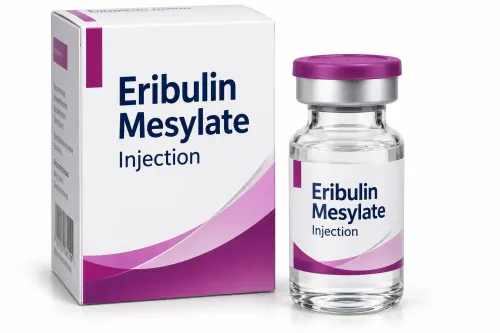
- Confirm the label states eribulin mesylate, concentration, total vial content, fill volume, intravenous route, and the approved product information used by the hospital.
Ask an eribulin injection international distributor whether the solution is administered undiluted or diluted in 100 mL of 0.9% sodium chloride injection. The technical pack must prohibit mixing with other medicines, require aseptic withdrawal, state in-use stability, and give the discard time for unused solution from a single-dose vial.
Do not infer dilution, storage after withdrawal, or a beyond-use period from a catalogue listing; use the approved product information and the hospital’s hazardous-drug procedure.
Which documents and Chilean authorizations must be confirmed before ordering?
Before payment, confirm both a complete shipment file and a lawful Chilean import route; an eribulin mesylate pharmaceutical exporter in Santiago is not sufficient evidence by itself.
Request these records for the exact batch and presentation:
- Current batch number, expiry date, certificate of analysis and finished-product specification.
- Manufacturer and packaging-site names and addresses, GMP evidence, stability data and batch-release records.
- Certificate of Pharmaceutical Product, or equivalent export documentation, plus authorized prescribing information.
- Commercial invoice, packing list and shipping conditions, including temperature monitoring and excursion handling.
- Recall and traceability records linking the batch to manufacture, release, shipment and the responsible contact.
The Instituto de Salud Pública de Chile (ISP) oversees sanitary registration and controls manufacture, importation, distribution, labeling and quality. The Santiago buyer must identify the importer of record, verify its sanitary authorization, and confirm prescription or institutional-use controls before ordering.
Check each identity against the Chilean registration or a documented lawful import pathway:
| Check | Acceptable evidence | What failure means |
|---|---|---|
| Product identity | Brand, manufacturer, eribulin mesylate strength and vial presentation match | Do not assume interchangeability |
| Legal status | ISP registration details or import authorization | Commercial documents do not authorize sale |
| Language | Spanish regulatory documents when ISP or the institution requires them | Translation or review remains outstanding |
Indian origin, an overseas GMP certificate, a commercial invoice or a Santiago business address does not prove Chilean market authorization. Obtain written confirmation of who holds the registration, who imports the shipment and who answers for complaints, recalls and batch defects.
How should a Santiago procurement team compare an eribulin exporter’s offer?
A low price does not compensate for an untraceable batch, unclear salt basis or an unusable temperature record. Give every eribulin oncology medicine supplier the same quote worksheet, including any eribulin injection international distributor:
| Quote field | Supplier’s answer | Evidence to attach |
|---|---|---|
| Identity | Eribulin mesylate basis, concentration, total vial content, fill volume, intravenous route and single-dose status | Specimen label and approved product information |
| Supply | Batch number, expiry date, available quantity and packaging configuration | Batch certificate and packing list |
| Delivery | Lead time, Incoterm, 20–25°C storage range, 15–30°C excursion allowance and monitoring method | Data logger report and shipping instructions |
| Accountability | Batch releaser, complaint and recall manager, and support for damaged, frozen, overheated or short-dated stock | Quality agreement and written procedure |
Compare completed evidence, not only unit price or minimum order quantity. Reject a quotation that describes “eribulin” without stating whether the strength is eribulin mesylate, or that substitutes “store below 30°C” for defined transport controls.
NIBA HEALTHCARE can enter this comparison as a potential India-based source, but request evidence for the specific product and shipment; a general oncology catalogue does not establish Chilean authorization. Confirm the importer of record and registration pathway separately.
At receipt, quarantine the shipment until you inspect:
- Carton and light protection
- Intact seal and correct label
- Batch, expiry and delivered quantity
- Temperature record, including excursions
Release only after the responsible quality unit resolves discrepancies, missing records or temperature damage.
Related product
 | Anti Cancer Injection Minimum order quanity 10 Vial Strength 0.44 mg/ml Packaging Type Vial Packaging Size 2 ml Vial STORAGE CONDITION Store below 30 Degree C Country of... View product → |
Frequently asked questions
When is eribulin mesylate clinically appropriate, and how is it dosed?
Use eribulin for its labeled oncology indications when the diagnosis and prior treatment history meet the approved criteria. The usual dose is 1.4 mg/m² given intravenously over 2 to 5 minutes on days 1 and 8 of a 21-day cycle; confirm the local product information and the patient’s organ-function adjustments.
How should a buyer reconcile concentration, vial strength and patient dose?
Calculate the prescribed dose in milligrams from body-surface area, then divide by the labeled concentration in mg/mL to determine the withdrawal volume. Check the vial’s total strength, concentration, route and permitted preparation volume before release.
What safety, preparation and transport controls must the hospital verify?
Verify cytotoxic-drug handling procedures, aseptic preparation, administration by intravenous route, package integrity, batch traceability and documented transport conditions. The hospital pharmacy must follow the approved product information for storage, dilution, beyond-use time and disposal.
Which documents and Chilean authorizations must be confirmed before ordering?
Request the current product information, certificate of analysis, manufacturing and batch details, commercial invoice, packing list, shipping documents and proof of Chilean ISP authorization or the applicable import approval. Match every document to the exact product, strength, batch and expiry date.
How should a Santiago procurement team compare an eribulin exporter’s offer?
Compare the registered product identity, vial strength, concentration, batch age, remaining shelf life, minimum order, lead time, Incoterm, temperature records, replacement policy and pharmacovigilance contact. Choose an eribulin oncology medicine supplier that can document each shipment rather than relying on price alone.