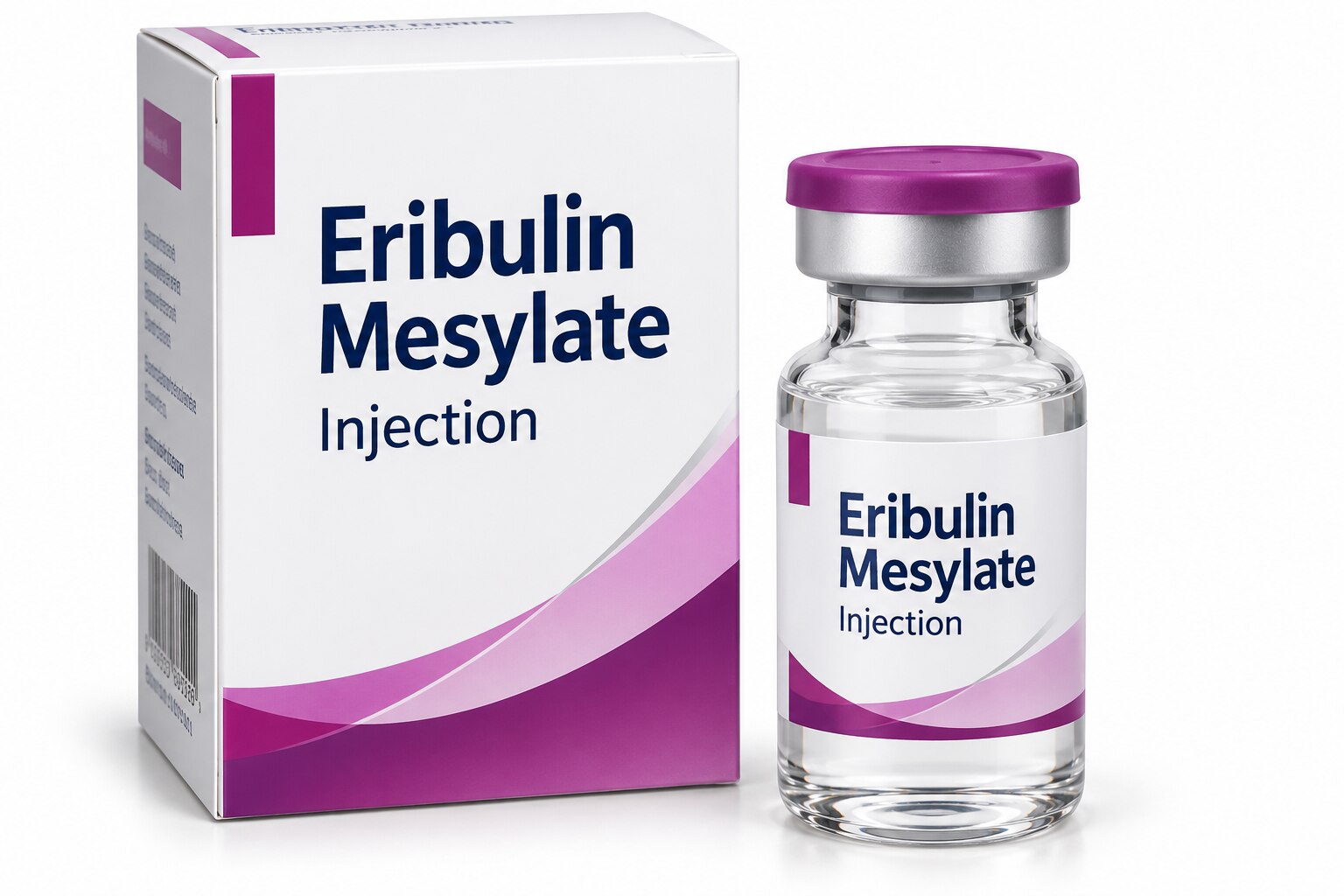
Eribulin procurement requires more than matching a medicine name to a vial: the indication, salt-equivalence statement, dose schedule, regulatory status, and transport record all affect whether a shipment is usable. By the end, you will know how to compare eribulin with alternative oncology treatments, check the product documentation, and qualify a supplier for Venezuelan import.
Key takeaways
- Match the prescribed dose to the vial concentration and final administration volume.
- Review cardiac, hepatic, renal, pregnancy, and blood-count risks before dosing.
- Request batch documents, temperature records, and a traceable certificate of analysis.
- Confirm Venezuela import licences, registration status, and delivery conditions before purchase.
When oncologists select eribulin mesylate—and when another medicine fits better
Eribulin mesylate is a cytotoxic microtubule-dynamics inhibitor used for two labelled settings: metastatic breast cancer after at least two chemotherapy regimens, including an anthracycline and a taxane where appropriate; and unresectable or metastatic liposarcoma after anthracycline-containing therapy. It is not interchangeable with a generic anti-cancer injection.
| Comparison point | Eribulin mesylate | Other medicines |
|---|---|---|
| Breast-cancer position | Later-line treatment after specified prior chemotherapy | Paclitaxel, capecitabine, sacituzumab govitecan, or other agents may fit earlier, biomarker-directed, or later-line care |
| Soft-tissue sarcoma position | Liposarcoma after anthracycline therapy | Doxorubicin, trabectedin, or other regimens may suit a different sarcoma subtype or treatment history |
| Evidence to verify | Trial population, prior regimens, response and survival outcomes | Confirm that the evidence matches the patient’s subtype, biomarkers and previous treatment |
| Treatment burden | Compare injection schedule, blood-count monitoring, neuropathy and QT-risk management | Compare each medicine’s infusion time, oral-adherence demands, organ limits and distinctive toxicities |
The purchasing decision should follow the oncologist’s treatment line, not the search phrase “anti cancer injection exporter in Caracas.” Ask whether the quoted product matches the prescribed indication, dose schedule and national label, then compare total monitoring and administration workload with the alternatives.
Choose another medicine when its evidence, biomarker fit, disease subtype or toxicity profile better matches the patient.
How to reconcile the vial strength with the prescribed dose
A 2 mL vial must be checked by both its stated salt strength and its eribulin equivalent. The commonly supplied presentation contains 1 mg eribulin mesylate in 2 mL, or 0.5 mg/mL, equivalent to 0.88 mg eribulin, or 0.44 mg/mL. Do not approve it by volume alone.
1. Match the vial label, carton, certificate of analysis, and purchase specification. Confirm “1 mg/2 mL eribulin mesylate,” the 0.88 mg eribulin equivalent, single-dose status, batch number, and expiry date. A listing for an eribulin mesylate injection exporter in Caracas does not replace this document check.
2. Use the prescribed body-surface-area dose expressed as eribulin mesylate. For a 1.4 mg/m² order and a body surface area of 1.70 m², calculate 2.38 mg; at 0.5 mg/mL, withdraw 4.76 mL, requiring three 2 mL vials. Recalculate any reduced dose from the actual order.
3. Confirm the schedule and route in the approved prescribing information: intravenous administration of the ordered dose over 2–5 minutes on Days 1 and 8 of a 21-day cycle.
4. Confirm preparation before compounding. The U.S. label permits dilution in 100 mL of 0.9% sodium chloride injection; do not substitute dextrose as an interchangeable diluent without product-specific instructions. The vial is preservative-free, so discard unused solution.
Which patient risks and pharmacy records must be checked before each dose
Before releasing each dose, require a current CBC, toxicity assessment, and prescriber sign-off. A sealed vial is not enough: eribulin requires cycle-specific decisions and traceable records.
- Confirm the CBC was taken before dosing and records ANC, platelet count, treatment day, and cycle.
- Review bilirubin, liver enzymes, serum creatinine or creatinine clearance, and documented peripheral neuropathy.
- Screen for congenital long-QT syndrome, heart failure, bradyarrhythmia, electrolyte abnormalities, and QT-prolonging medicines. Correct electrolytes and obtain an ECG when cardiac risk cannot be avoided.
- Record the indication, dose in mg/m², patient BSA, dose level, laboratory results, prescriber decision, vial strength, batch number, and administration date.
| Finding | Dispensing decision | Record to verify |
|---|---|---|
| ANC below 1,000/mm³ or platelets below 75,000/mm³ | Withhold; on day 8, reduce for ANC 500–1,000 or platelets 50,000–75,000; omit below those lower thresholds | Dated CBC and dose decision |
| Grade 3 or 4 peripheral neuropathy | Withhold; resume one dose level lower after recovery to grade 2 or less; discontinue if unresolved within three weeks | Neuropathy grade and reassessment |
| Moderate hepatic or moderate/severe renal impairment | Start at 1.1 mg/m²; severe hepatic impairment requires 0.7 mg/m² under the U.S. label | Organ-function assessment and label used |
| QT risk or congenital long-QT syndrome | Avoid congenital long-QT syndrome and QT-prolonging combinations where possible; consider ECG monitoring | Medication review, electrolytes, and ECG when indicated |
How to verify product quality, temperature handling, and batch traceability
A quotation is not proof of quality. Match the quoted presentation to the approved label: a single-dose vial should state 1 mg eribulin mesylate in 2 mL, equivalent to 0.88 mg eribulin, with the batch number, expiry date, manufacturer, and storage statement visible on the label and carton.
| Document | What it proves | Query or reject when |
|---|---|---|
| WHO-GMP or Indian GMP certificate | The named site operates under a recognised manufacturing system | The certificate names another site or expired before production |
| Venezuelan registration or import authorisation, plus certificate of pharmaceutical product where applicable | The presentation is legally eligible for the destination market | The exporter offers only a manufacturing certificate |
| Batch certificate of analysis and batch-release record | The specific batch met identity, assay, sterility, and release specifications | Documents show a different batch, strength, or manufacturer |
| Stability data and approved product information | The labelled shelf life and storage limits are supported | The seller gives only a generic temperature claim |
For the shipment, request calibrated data-loggers covering loading, transit, customs storage, and delivery. The U.S. label specifies controlled room temperature of 20–25°C, with excursions from 15–30°C; routine refrigeration is not required. “Cold chain” is not automatically safer, because freezing can damage a product labelled for room-temperature storage.
Require the exporter to investigate every excursion and provide the logger report, calibration certificate, packaging specification, and written disposition before release. Keep the purchase order, invoice, packing list, airway bill, photographs, and receiving log tied to the same batch and serial or shipment reference.
How a Caracas oncology buyer qualifies the exporter and import route
A search result calling a company an “eribulin mesylate pharmaceutical exporter in Caracas” is geographically imprecise. An Indian exporter ships from India; a Caracas company is normally the importer, distributor, or local supplier.
Ask for the Indian manufacturing site, legal exporter of record, Venezuelan importer of record, and the address where the stock is physically held.
Before issuing a purchase order, verify:
- The eribulin product’s Venezuelan sanitary registration and registered presentation with the Instituto Nacional de Higiene Rafael Rangel or the competent Venezuelan medicines authority.
- The licensed local importer named on the registration or import file, plus any current import permit required for a cytotoxic antineoplastic.
- Spanish labeling, package insert, storage wording, and the importer’s name on the pack; an Indian GMP or WHO-GMP certificate does not replace Venezuelan marketing authorization.
- The Certificate of Pharmaceutical Product, if required for the route, the batch certificate of analysis, batch-release record, stability data, and evidence that the named Indian site manufactures the quoted vial.
- The pro forma invoice showing quantity, currency, payment terms, Incoterms 2020 rule, freight and insurance payer, customs responsibility, and delivery point.
NIBA HEALTHCARE should identify whether it is quoting as the Indian exporter or through a Caracas partner. That distinction determines who supplies customs documents, handles clearance, bears loss during transit, and accepts responsibility for delivery. Treat an “eribulin injection supplier in caracas” listing as a lead, not proof of lawful availability or local stock.
Verify the import path directly before payment.
Related product
 | Anti Cancer Injection Minimum order quanity 10 Vial Strength 0.44 mg/ml Packaging Type Vial Packaging Size 2 ml Vial STORAGE CONDITION Store below 30 Degree C Country of... View product → |
Frequently asked questions
When is eribulin mesylate selected for cancer treatment?
Its labelled uses include metastatic breast cancer after at least two chemotherapy regimens, including an anthracycline and a taxane where appropriate, and unresectable or metastatic liposarcoma after anthracycline-containing therapy. The treating oncologist must confirm whether the patient fits the indication.
How do you reconcile an eribulin vial with the prescribed dose?
Check the concentration printed on the vial, calculate the required volume from the prescribed milligram dose, and compare the calculation with the pharmacy record before preparation. Do not assume that vial size equals the patient dose.
Which records should be checked before each eribulin dose?
Review the current prescription, patient identity, treatment cycle, complete blood count, liver and kidney results, pregnancy status when relevant, prior toxicities, and medicines that increase cardiac or other treatment risks.
How can a buyer verify eribulin product quality and traceability?
Match the product name, strength, batch number, expiry date, seal, and manufacturer across the vial, carton, invoice, and certificate of analysis. Request storage and transport records, then investigate any temperature excursion or broken packaging.
What should a Caracas oncology buyer verify before selecting an exporter?
Confirm the exporter’s legal identity, manufacturing and distribution documents, product registration or import pathway, certificate of analysis, batch traceability, cold-chain plan, shipping documents, and the Venezuelan importer’s required licences before payment or dispatch.