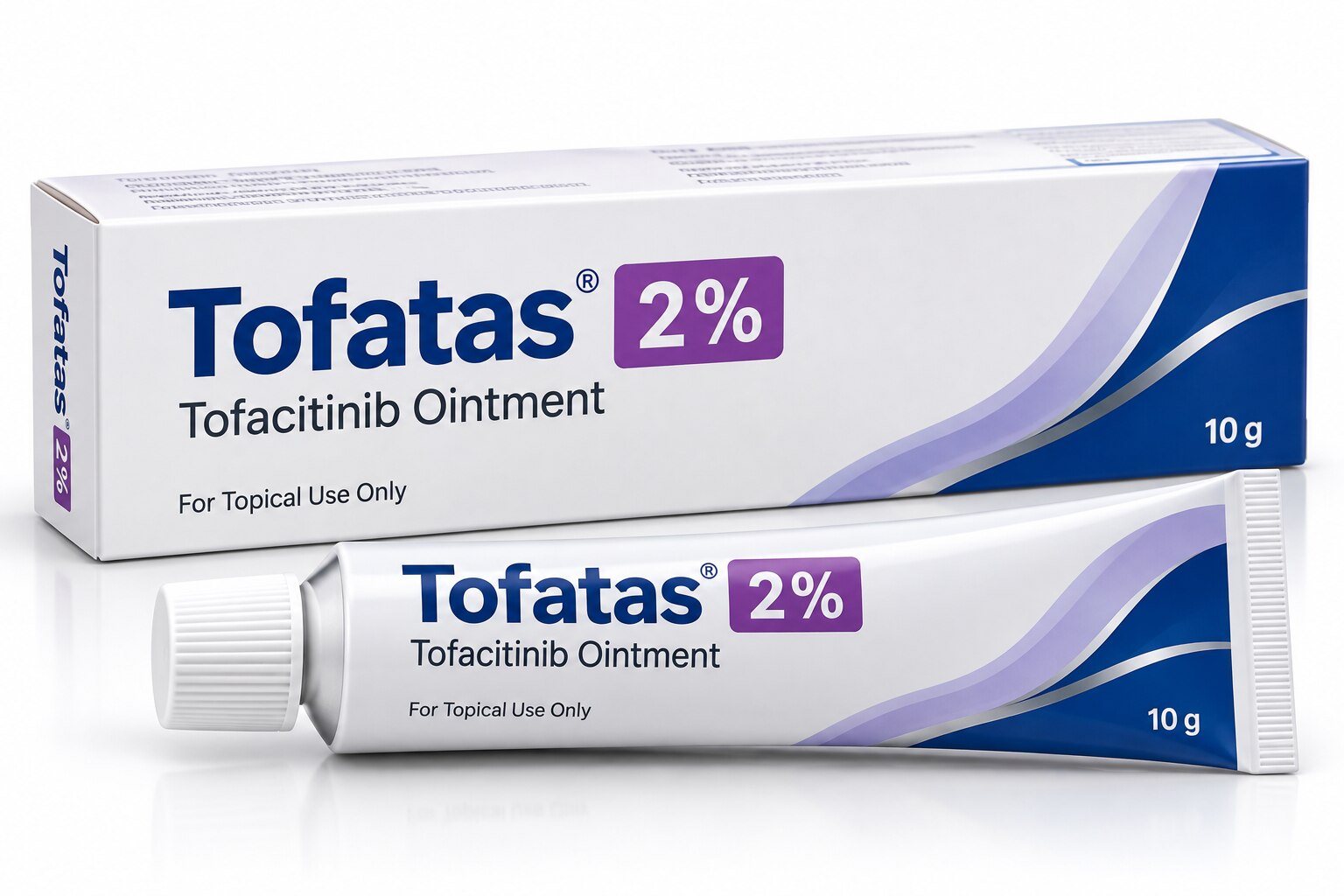
A Brasília buyer needs more than a catalogue listing before ordering this medicine: the product’s Brazilian sanitary status, batch evidence, packaging, landed cost and commercial supply route must all be confirmed. Use the checks below to separate a genuine wholesale quotation from an unverified offer and prepare the documents required for lawful procurement.
Key takeaways
- Match the product with ANVISA’s database before requesting a quote.
- Ask for the exact tube, formula, batch number, and certificate documents.
- Calculate freight, taxes, customs fees, and storage in the landed cost.
- Verify the exporter, manufacturing site, licences, and shipment temperature controls.
Confirm the product and its Brazilian sanitary status before requesting a quote
A search result for “Tofatas 2 percent ointment supplier in Brasília” does not prove Brazilian authorization. Match the offered product against ANVISA’s product database using the exact name, manufacturer, active ingredient, strength, dosage form and sanitary status.
If no matching record exists, stop the order and obtain a written regulatory determination before treating it as eligible for commercial distribution.
1. Request the product’s regulatory identification, manufacturer details and evidence that the intended Brazilian importer or distributor holds sanitary authorization for its activity. An Indian exporter’s invoice or international shipping history does not authorize dispensing or wholesale distribution in Brazil.
2. Confirm that the intended channel permits the product’s sale and that it is prescription-only where applicable. Ask how the supplier will meet Portuguese labelling, lot identification, expiry dating and traceability requirements; a label designed only for India is not sufficient.
3. For tofacitinib topical procurement, obtain clinical-use documentation stating the indication, application frequency, treatment duration and studied formulation. A published reference to tofacitinib does not validate this specific 2% ointment.
4. Check that 2% means 20 mg of tofacitinib per gram of finished ointment, then request the specification and certificate of analysis. The percentage alone does not identify the salt form, vehicle, particle size, release profile, stability period or topical bioavailability.
Commercial importation into Brazil requires the applicable ANVISA controls and importer documentation. Do not request a wholesale quote until the product identity and intended Brasília distribution channel pass those checks.
Ask for the exact tube, ointment formula and batch documentation
Do not compare a Tofatas ointment wholesale quotation until the supplier identifies the exact finished product, not merely “tofacitinib 2%.” Confirm the tube’s net weight, tube material, tamper evidence, individual carton, label markings, batch-number format, manufacturing date, expiry date and remaining shelf life at dispatch.
Request this lot-level file before discussing price:
- Product specification naming tofacitinib, its salt form, concentration and ointment vehicle. A 2% preparation contains 20 mg per gram, but that percentage does not reveal the excipients, particle size, release profile or topical bioavailability.
- Complete excipient list, colour, odour, appearance and identification test.
- Certificate of analysis for the offered batch, showing assay, identification, microbial limits and physical-description results.
- Batch number, manufacturing date, expiry date, quantity available and storage conditions, including any temperature limit.
- Packaging configuration: tubes per carton, cartons per case, tube net weight, primary-pack material and seal or tamper evidence.
- Clinical-use documentation stating the studied indication, application frequency, treatment duration and formulation. A paper about tofacitinib does not validate this commercial ointment.
| Evidence | Acceptable detail | Disqualifying gap |
|---|---|---|
| Certificate of analysis | Batch-specific results and signatures | Generic template or catalogue image |
| Formula | Named excipients and vehicle | “2% ointment” alone |
| Storage | Defined temperature and handling conditions | No storage statement |
| Traceability | Batch, dates and quantity match the quote | Mismatched or missing lot data |
Compare wholesale quotations with the real landed cost in Brasília
Compare quotations only after converting each into a Brasília landed-cost sheet. A search result labelled “tofatas 2 percent ointment supplier in brasília” is not a price or delivery commitment. Ask whether the offer covers commercial stock, and record the currency, quotation validity, Incoterm, minimum order quantity and expected shelf life at dispatch.
| Quotation line | Request from the supplier | Effect on landed cost |
|---|---|---|
| Product | Unit price, tube net weight, tubes per carton, cartons per case and MOQ | Reveals the true cost per tube and unused packaging |
| Freight | Airport or port, freight, insurance, delivery to Brasília and lead time | Adds international transport and inland delivery |
| Import charges | Brazilian import taxes, customs brokerage, sanitary clearance and broker fees, shown separately | Prevents an artificially low supplier price |
| Storage and terms | Required temperature range, payment schedule, bank charges and credit terms | Captures handling costs and cash tied up before sale |
For a tofatas ointment wholesale enquiry, request a pro forma invoice that identifies the exact pack, batch allocation, carton dimensions, gross weight, dispatch date and remaining shelf life. Confirm whether the supplier quotes EXW, FOB, CIF or DDP; do not compare those bases as if they were equivalent.
Ask for these commercial details in writing:
- MOQ by tube, carton and case, including any sample-order minimum
- Payment split, accepted currency, bank charges and balance trigger
- Production lead time after payment and estimated transit time to Brasília
- Freight forwarder, insurance responsibility and temperature or storage controls
- Charges excluded from the unit price, including customs, taxes, brokerage and final delivery
A “toफatas ointment wholesale” offer is incomplete until every exclusion has a value or a named payer.
Verify the exporter, manufacturing site and shipment controls
1. Verify the site before judging the seller. Ask the tofacitinib ointment supplier for its Indian manufacturing licence, full manufacturing-site address, current GMP evidence, and confirmation that the named site produces the quoted ointment. “Made in India” and “pharmaceutical exporter” describe trade activity, not batch quality.
Check that the documents identify the same manufacturer and product shown on the quotation.
2. Request a lot-specific release file before approving a sample or order. It should show the batch number, manufacturing and expiry dates, quantity, assay, identification, microbial limits, physical description, packaging configuration, and labelled storage conditions. Also obtain a named complaint and recall contact.
A catalogue image, export invoice, or generic certificate is not a batch-release record.
3. Test the shipping plan against the label, not an assumed cold chain. Require the proposed outer packaging, protection from heat, light and moisture where specified, carrier details, dispatch-to-delivery estimate, and temperature records when the product’s storage conditions require them.
Reject unexplained temperature excursions, damaged seals, wet cartons, or tubes with unreadable batch and expiry markings.
4. Make the pre-order sample representative. Request a sealed tube from the same manufacturing site, formulation, primary pack, and intended commercial batch type, with its certificate of analysis and clinical-use documentation identifying the studied indication, application frequency, and treatment duration.
Do not treat a literature reference to tofacitinib as proof that this 2% ointment is suitable.
NIBA HEALTHCARE should answer these requests with documents tied to the actual product, not broad exporter credentials. Before payment, confirm the Brazilian importer’s sanitary authorisation, prescription controls, and ability to receive Portuguese labelling and traceability records.
Related product
 | TOFACITINIB OINTMENT 2% TOFATAS Ointment is used to treat atopic dermatitis and hair loss (androgenetic alopecia). |
Prepare Brazil’s import, labelling and distribution file
Commercial stock cannot rely on a patient-import exception. Before shipment, confirm that the exact Tofatas product has a Brazilian sanitary pathway for wholesale distribution; an Indian tofatas pharmaceutical exporter’s invoice or export licence does not authorise sale in Brasília.
Build the file with these checks:
- Match the manufacturer, active ingredient, 2% strength, ointment dosage form and pack against ANVISA’s product database. If the exact product has no applicable Brazilian authorisation, stop the ordinary commercial order.
- Confirm the importer’s CNPJ, ANVISA AFE and activity scope, plus any additional authorisation required for the product and channel. Confirm that the Brasília distributor is authorised to store and distribute prescription medicines.
- Prepare the import declaration, commercial invoice, packing list, transport document, purchase order, batch certificate of analysis, manufacturing and expiry details, and the documents requested for ANVISA sanitary clearance.
- Obtain Portuguese labelling and package-insert artwork before printing. Check product name, active ingredient, strength, pharmaceutical form, batch, expiry, manufacturer, importer, registration number and storage instructions.
- Record the distribution trail from customs release to the authorised warehouse, including batch and expiry. Do not release stock whose seal, label or traceability record fails inspection.
| Check | Evidence to retain | What failure means |
|---|---|---|
| Brazilian status | ANVISA database record and regulatory decision | Do not market through normal wholesale distribution |
| Importer eligibility | AFE, CNPJ and activity scope | Shipment or distribution can be blocked |
| Product quality | Certificate of analysis and batch records | Hold the lot pending investigation |
| Language and traceability | Approved Portuguese artwork and batch log | Stock cannot be safely released |
For tofacitinib topical procurement, keep the clinical-use file too: indication, application frequency, treatment duration and studied formulation. Literature about tofacitinib alone does not validate a commercial 2% ointment.
Frequently asked questions
How do you confirm Tofatas 2% ointment’s Brazilian sanitary status?
Search ANVISA’s product database using the exact product name, manufacturer, active ingredient, 2% strength, ointment dosage form, and sanitary status.
What documents should you request for Tofatas ointment wholesale?
Request the exact tube specification, ointment formula, batch number, certificate of analysis, manufacturing details, shelf life, and batch-release documentation.
How do you compare Tofatas ointment supplier quotations in Brasília?
Compare the full landed cost, including product price, freight, insurance, import taxes, customs charges, broker fees, storage, and local delivery.
What should you verify about a tofacitinib ointment supplier?
Verify the exporter’s legal identity, manufacturing site, licences, quality documents, packaging controls, shipment conditions, and temperature records when required.
What belongs in Brazil’s import and distribution file?
Prepare the commercial invoice, packing list, transport document, product and batch records, Brazilian labelling, import documentation, customs records, and distribution traceability file.