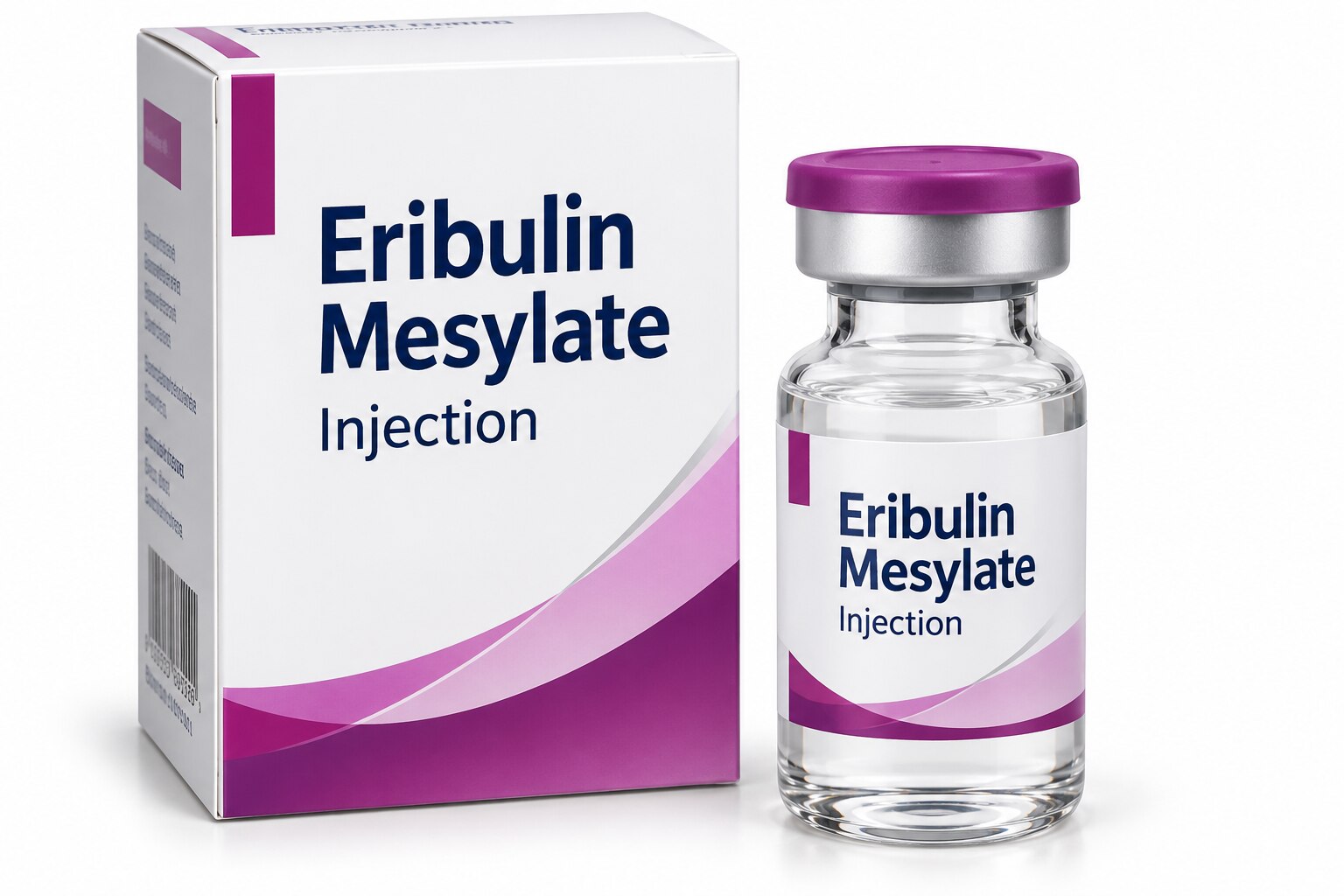
Eribulin mesylate is used in specific advanced cancers, and its dose depends on body-surface area, organ function, toxicity, and the exact product label. You will be able to assess whether a proposed product is clinically appropriate, calculate the required volume, identify administration risks, and screen an international shipment for Brazilian regulatory and quality requirements.
Key takeaways
- Use 1.4 mg/m² on days 1 and 8 of a 21-day cycle when the approved regimen applies.
- Calculate the patient dose before opening vials and document any unused-volume wastage.
- Verify blood counts, liver function, neuropathy, and QT-risk medicines before each administration.
- Request ANVISA, GMP, batch, temperature, and export documents from every Brasília supplier.
When Eribulin Mesylate Is an Appropriate Treatment
Eribulin is an established option for adults with metastatic breast cancer after at least two chemotherapy regimens for advanced disease, including an anthracycline and a taxane unless those drugs were unsuitable. It is also indicated for unresectable or metastatic liposarcoma after an anthracycline-containing regimen.
The usual schedule is 1.4 mg/m² intravenously over 2–5 minutes on days 1 and 8 of a 21-day cycle, adjusted for toxicity and organ function.
| Clinical history | Eribulin fit | When another option is more appropriate |
|---|---|---|
| Metastatic breast cancer after anthracycline and taxane | Established candidate | Earlier-line therapy has not yet been used |
| Unresectable or metastatic liposarcoma after anthracycline | Established candidate | The tumour is resectable or has not received anthracycline |
| Severe neuropathy, persistent cytopenias, or prior serious eribulin toxicity | Requires specialist reassessment | Choose treatment with a more suitable toxicity profile |
A patient with moderate or severe hepatic or renal impairment starts at 1.1 mg/m², not 1.4 mg/m²; recurrent toxicity permits reduction to 0.7 mg/m². Blood counts and neuropathy status matter before treatment continues.
A search for eribulin mesylate injection for pharmaceutical exporter brasilia does not establish clinical suitability: the oncologist must match the indication, prior drugs, disease intent, and current organ function to the prescribing information.
How to Calculate the Dose and Account for Vial Wastage
Calculate each administration from body-surface area, not from the vial size. The labeled dose is 1.4 mg/m² intravenously on days 1 and 8 of a 21-day cycle, unless the prescribing information specifies a reduction.
1. Multiply the patient’s body-surface area by 1.4. A patient with a BSA of 1.70 m² requires 2.38 mg.
2. Convert the calculated dose using the labeled equivalent concentration. At 0.5 mg/mL of eribulin, 2.38 mg requires 4.76 mL. Confirm any dose-rounding rule with the oncology pharmacy; do not round independently.
3. Divide the required volume by 2 mL per single-dose vial and round up to whole vials. The 4.76 mL dose uses three vials, leaving 1.24 mL for disposal. Never save or pool the remainder because the vial contains no antimicrobial preservative.
A concentration listed as 0.44 mg/mL needs reconciliation before procurement. That figure can describe eribulin mesylate itself, while the labeled strength may state 0.5 mg/mL eribulin equivalent, or 1 mg in a 2 mL vial. Multiplying 0.44 by 2 and treating 0.88 mg as the patient dose creates a false shortfall.
Request the approved label, strength expression, fill volume, and certificate of analysis before comparing eribulin mesylate injection wholesale offers by cost per administered dose rather than cost per vial.
Clinical Checks Before Each Dose
Before each dose, confirm that blood counts, organ function, neurologic status, cardiac risk, and the previous cycle’s toxicities still support treatment. A normal-looking injection does not make an unsafe dose safe.
1. Check a complete blood count with differential. Hold treatment if the absolute neutrophil count is below 1,000/mm³, platelets are below 75,000/mm³, or the patient has grade 3 or 4 nonhaematologic toxicity. Investigate fever or infection urgently because neutropenia can progress to sepsis.
2. Review hepatic and renal function. Start at 1.1 mg/m² for moderate or severe hepatic impairment, or moderate or severe renal impairment. If toxicity returns after a reduction, reduce to 0.7 mg/m²; discontinue treatment if 0.7 mg/m² is not tolerated.
3. Ask about numbness, burning pain, weakness, gait changes, and impaired daily activities. Peripheral neuropathy can worsen with cumulative exposure; withhold treatment for severe neuropathy and reassess before restarting.
4. Review fatigue, mucositis, gastrointestinal symptoms, and prior dose delays. Do not give the next dose until significant nonhaematologic toxicity has recovered to grade 2 or below.
5. Check congenital long-QT syndrome, bradyarrhythmia, heart failure, prior ventricular arrhythmia, and medicines that prolong QT. Correct hypokalaemia or hypomagnesaemia and review whether an ECG is needed; avoid eribulin with QT-prolonging drugs where possible.
Document the assessment, dose decision, and adverse-event plan in the treatment record. Confirm that the current prescribing information and pharmacovigilance contact are available for unexpected reactions.
Safe Handling, Intravenous Administration, and Transport Conditions
Verify the vial before it enters the preparation area: confirm eribulin mesylate, 0.5 mg/mL strength, 2 mL single-dose presentation, batch number, expiry date, intact seal, and a clear solution without particles or unexpected colour. Reject a vial with a cracked container, leaking closure, damaged label, or questionable appearance.
- Handle the preservative-free solution with aseptic technique in the facility’s approved hazardous-drug area. Do not reconstitute it. Withdraw only the calculated volume; never pool leftover solution from single-dose vials.
- Use it undiluted or dilute it only with 0.9% sodium chloride injection when that option appears in the product’s approved instructions. Do not assume dextrose, balanced electrolytes, sterile water, or another parenteral fluid is compatible, and do not mix eribulin with another medicine in the same infusion.
- Confirm IV access and patency before administration. Give the dose intravenously over 2 to 5 minutes through a secure line, observing the site for pain, burning, swelling, redness, or leakage. Stop immediately for suspected extravasation and follow the institution’s cytotoxic-extravasation protocol.
- Keep the vial and prepared syringe or bag protected from light. Store and transport at 20°C to 25°C, allowing only documented excursions from 15°C to 30°C; use a temperature logger and retain the excursion record.
- Place unused solution, needles, syringes, gowns, and contaminated materials in labelled cytotoxic-waste containers. Do not return opened vials to stock or discard them in general waste.
How to Qualify an Eribulin Supplier for Delivery to Brasília
Do not release a purchase order until the exporter proves that the proposed presentation can legally enter Brazil and matches the product your hospital intends to use. Brasília is the delivery destination, not a separate medicines-approval jurisdiction.
1. Ask for the ANVISA registration number, or the specific legally applicable exceptional-import authorization, plus the registered manufacturer, manufacturing site, Brazilian importer of record, Portuguese label and package insert. A WHO-GMP certificate or foreign Certificate of Pharmaceutical Product supports due diligence; neither replaces Brazilian authorization.
2. Request the batch number, certificate of analysis, release certificate, manufacturing and expiry dates, sterility result, assay, endotoxin result, container-closure inspection and temperature records. Confirm that the label states the approved concentration, fill volume, vial type and single-dose status. Investigate any mismatch between a 0.44 mg/mL quotation and the authorized product information before payment.
3. Require the commercial invoice, packing list, airway bill, transport conditions, product and batch details, import-license documentation and records linking that batch to the Brazilian importer and authorized product. Ask who handles ANVISA clearance and quality complaints, adverse-event reports and recalls.
4. Compare landed cost per administered dose, not per vial. Add freight, insurance, customs charges, taxes, clearance, Brasília delivery and disposal of unused single-dose solution; request the minimum order, expected shelf life on arrival and a written wastage assumption.
NIBA HEALTHCARE should provide this evidence before a buyer treats it as an eribulin mesylate exporter brasilia or eribulin injection supplier brazil.
Related product
 | Anti Cancer Injection Minimum order quanity 10 Vial Strength 0.44 mg/ml Packaging Type Vial Packaging Size 2 ml Vial STORAGE CONDITION Store below 30 Degree C Country of... View product → |
Frequently asked questions
When is eribulin mesylate an appropriate treatment?
It is indicated for adults with metastatic breast cancer after anthracycline- and taxane-containing therapy, unless unsuitable, and for unresectable or metastatic liposarcoma after an anthracycline regimen.
How is the eribulin injection dose calculated?
Calculate 1.4 mg/m² from the patient’s body-surface area, then administer the approved schedule of days 1 and 8 in a 21-day cycle. Apply renal, hepatic, and toxicity-related adjustments from the prescribing information.
What clinical checks are needed before each eribulin dose?
Review complete blood count, liver and kidney function, peripheral neuropathy, infection signs, prior toxicities, and medicines that increase QT-prolongation risk.
How do you qualify an eribulin supplier for delivery to Brasília?
Check the supplier’s ANVISA authorization, product registration or import pathway, GMP evidence, batch release documents, certificate of analysis, packaging, expiry, and validated transport records.