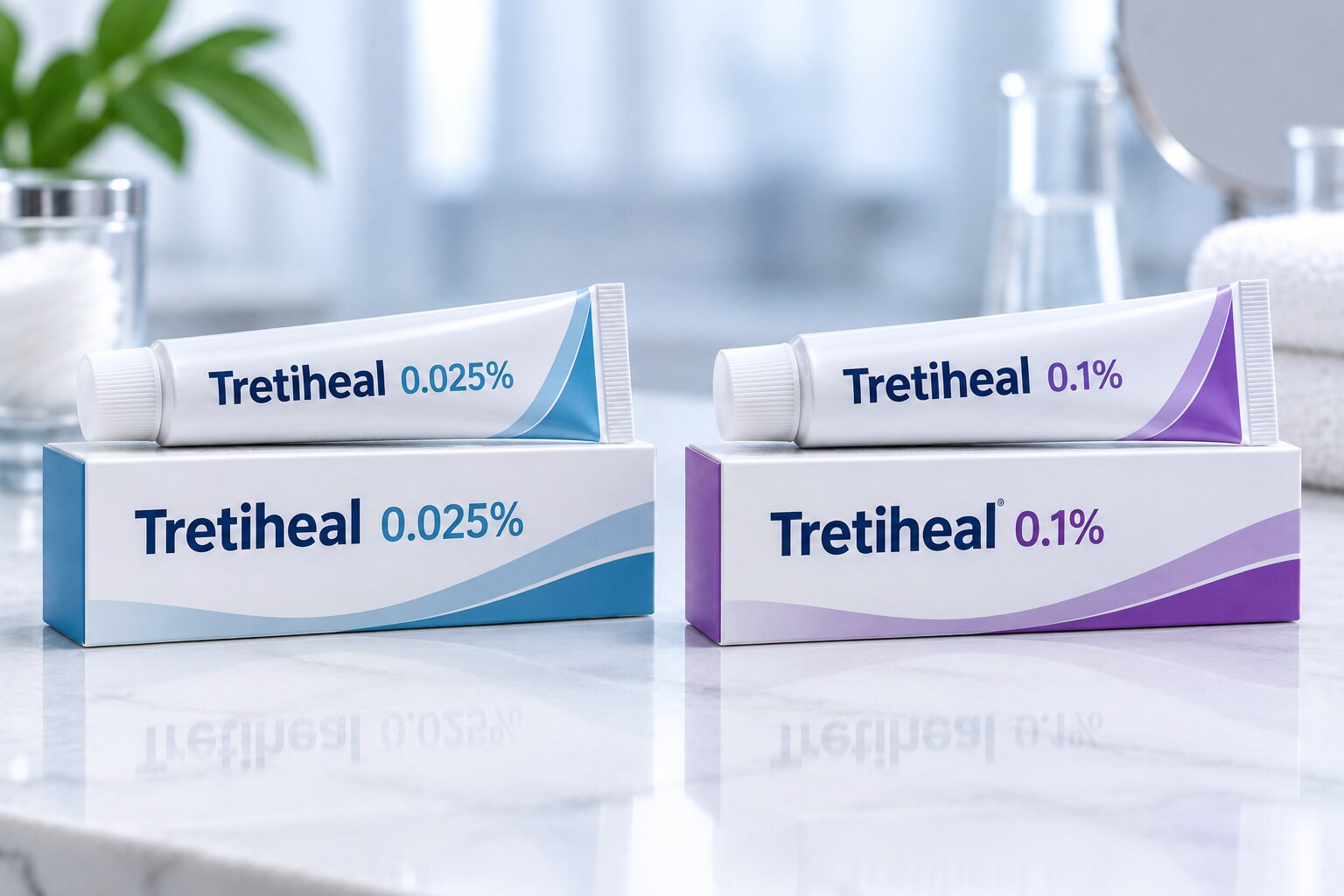
The first decision is not whether 0.1% sounds more powerful; it is whether “0.025” has been written correctly and whether users can apply the selected strength consistently. By the end, buyers will be able to distinguish 0.025% from 0.25%, match each strength to user tolerance, and compare finished-product and supply requirements before ordering.
Key takeaways
- Confirm that 0.025% means 0.025%, not 0.25%.
- Choose the strongest formula users can tolerate consistently.
- Review application, packaging, batch records, and finished-product documents.
- Check Chile and destination-market licences before placing a wholesale order.
First, confirm whether 025 means 0.025% or 0.25%
“0 point 025” normally means 0.025%, not 0.25%. In the Tretiheal 0 point 025 vs 0 point 1 cream comparison, the percentage describes tretinoin concentration in the cream, not the tube size or package configuration.
| Strength | Tretinoin per gram | Relative concentration |
|---|---|---|
| 0.025% | 0.25 mg/g | 1× |
| 0.1% | 1 mg/g | 4× |
| 0.25% | 2.5 mg/g | 10× versus 0.025% |
Therefore, 0.1% contains four times as much tretinoin per gram as 0.025%. It is not simply a larger tube, a different pack count or a higher net fill. A quotation marked only “025” is incomplete because it does not establish whether the supplier means 0.025% or another code.
Before comparing prices, reconcile the product name across the carton, tube, approved label, purchase order and certificate of analysis. Confirm that each document identifies the same percentage, dosage form and active-ingredient specification. If one document says 0.025% and another says 0.25%, stop the comparison and request written clarification before ordering; those are materially different strengths.
Choose the strength users can tolerate and use consistently
0.025% is the more sensible starting discussion for tretinoin-naive users and people prone to dryness, burning, redness or peeling. For a tretiheal cream strengths comparison, match concentration to the user’s ability to maintain treatment, not to the largest number on the carton.
| User profile | More appropriate discussion | Reason |
|---|---|---|
| Tretinoin-naive | 0.025% | Builds tolerance with a lower irritation burden |
| Sensitive or dry skin | 0.025% | Reduces the risk of dermatitis disrupting treatment |
| Acne-prone skin | 0.025% if new or easily irritated | Treat the whole acne-prone area without spot over-application |
| Experienced user | 0.1% only in a clinician-directed plan | Consider it only after established tolerance and a clear reason |
| Photodamage treatment | 0.025% to start; 0.1% only with clinical direction | The indication and tolerability determine escalation |
A stronger cream is not automatically faster or better. If 0.1% causes peeling or burning that leads to skipped applications or discontinuation, consistently using 0.025% can produce more useful treatment exposure than intermittently applying 0.1%.
Make the final choice with the treatment indication, skin condition, concurrent products and local prescribing rules. Abrasive cleansers, alcohol-heavy preparations, peeling agents and other acne medicines can increase irritation, so assess the complete protocol rather than concentration alone.
Have a clinician direct 0.1% when prior tretinoin use is well tolerated and a higher concentration has a defensible purpose.
Set up use correctly before judging results
Use either strength at night, after washing and waiting until the skin is fully dry. Apply one pea-sized amount as a thin film across the entire affected or acne-prone area, not individual pimples; adding more will not speed improvement and increases irritation.
1. Start at the prescribed frequency. Support the skin with a plain moisturiser, and apply broad-spectrum sunscreen every morning. Keep tretinoin away from the eyes, lips and broken skin.
2. Avoid abrasive cleansers, alcohol-heavy preparations, peeling agents and other irritating acne medicines unless a clinician directs their combination. These products strip the barrier and can intensify dermatitis, burning and peeling.
3. Treat tightness, peeling, burning, redness or temporary acne worsening as signals to reduce application frequency or pause. Obtain medical advice for severe or persistent reactions, swelling, blistering or marked pain.
4. Do not judge either strength after a few applications. NICE guideline NG198, Acne vulgaris, uses a 12-week review point for initial acne treatment; review the response at that interval before changing strength. Improvement can lag behind irritation, so a consistently used lower strength can outperform a stronger one used intermittently.
Use moisturiser before or after tretinoin if your clinician or product information supports that routine, but do not apply a thicker tretinoin layer to compensate for delayed results. A clinician should assess ongoing worsening, suspected dermatitis or treatment failure rather than an unsupervised jump to 0.1%.
Check the finished product, not just the percentage
Two creams labelled 0.025% can behave differently. Compare the cream vehicle, excipient list, particle size or crystal form, pH, preservatives, tube and carton, light protection, stability data and manufacturing controls; these differences affect spreadability, irritation and shelf stability despite the same nominal strength.
For a tretiheal 0 point 025 wholesale quotation, require:
- Exact strength and active-ingredient specification, dosage form, tube fill, pack configuration and minimum order quantity.
- Remaining shelf life at dispatch, approved storage temperature, transport excursion allowance, batch number, certificate of analysis and batch-release documents.
- Permitted markets, including whether the supplied presentation is approved for your destination.
Request current GMP evidence for the manufacturing site, product specifications, representative-batch certificates of analysis, stability or retest data, change-control history and the destination-market registration dossier. A generic GMP claim does not prove that this specific cream is compliant.
Read the approved label and stability file before arranging freight. They determine the storage range, light-protection requirement and whether refrigerated transport is needed; do not infer refrigeration from the product category. Ask how the manufacturer protects the cream from excessive heat and light, and whether packaging changes have been assessed through formal change control.
A price comparison that omits these details can place unlike finished products in the same table.
Apply Chile and destination-market checks before buying
A Santiago address proves where a seller operates, not that it is authorised to supply tretinoin. Before you buy tretinoin cream from Chile, verify the medicine’s legal status in both countries.
1. For a Tretiheal 0 point 025 cream supplier in Santiago, request the Chilean sanitary registration, importer or distributor authorisation, prescription classification and Spanish-language label. Confirm that the carton and tube show the lot number, expiry date and exact presentation, then match them to the commercial invoice for traceability.
2. Check Chilean dispatch rules before payment, including whether the seller may release a prescription medicine for export. Separately, confirm the destination country’s prescription-drug import requirements; a tretinoin medicine is not an unrestricted cosmetic simply because it is sold online.
3. Ask NIBA HEALTHCARE, or any other supplier, for the named product dossier, batch records, certificate of analysis, current GMP evidence, market authorisation and documents matching the supplied strength, tube fill and dosage form. A generic export statement or GMP claim does not prove that this specific product is marketable in Chile or your destination.
Select 0.025% for a lower-irritation entry strategy when clinically appropriate. Consider 0.1% only with a justified clinical and regulatory plan; never let concentration alone determine the order.
Related products
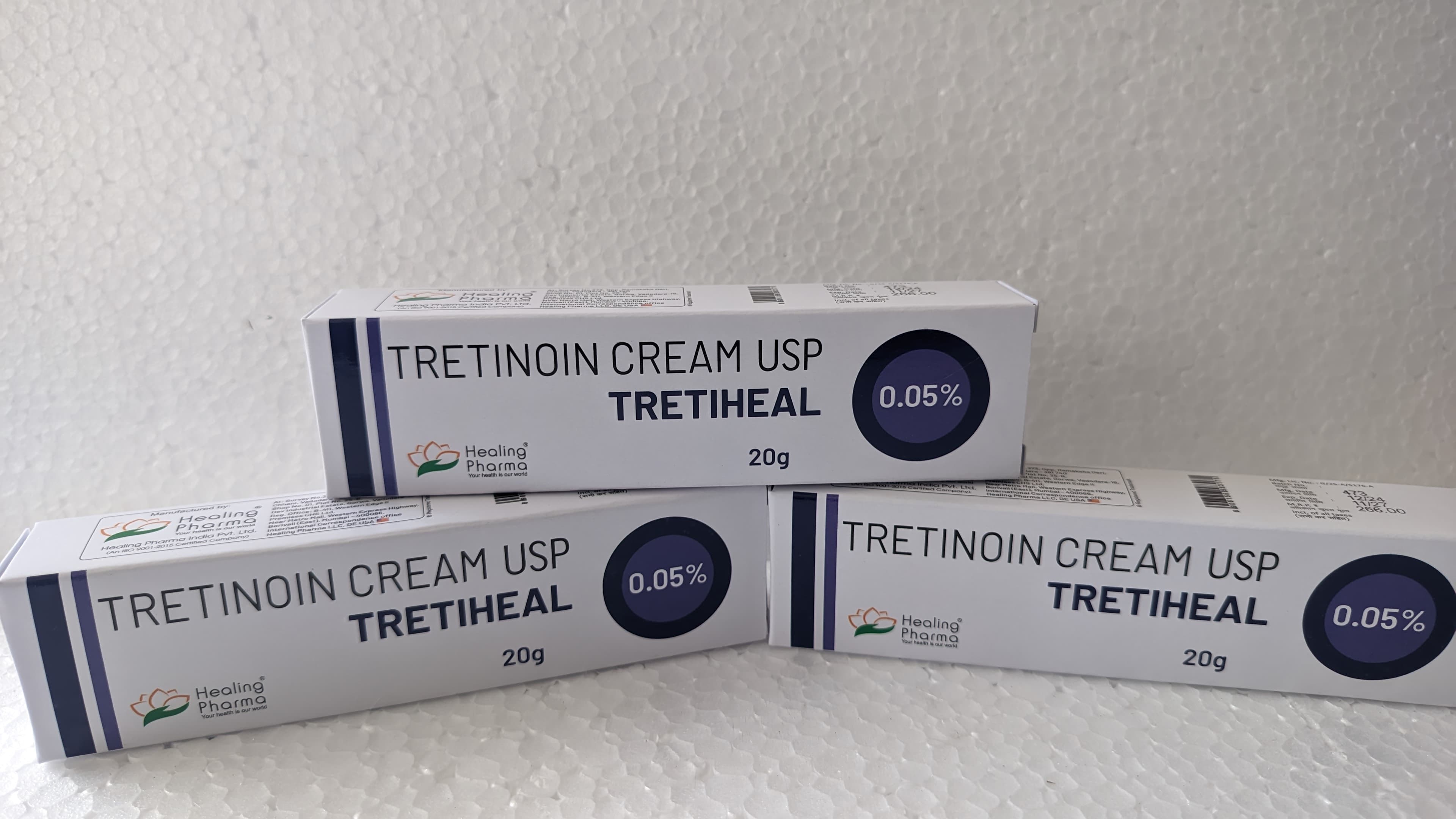 | TRETINOIN CREAM 0.05% Tretiheal 0.05% Cream is a form of vitamin A that is used to treat acne which appears as spots or pimples on your face, chest, or back. View product → |
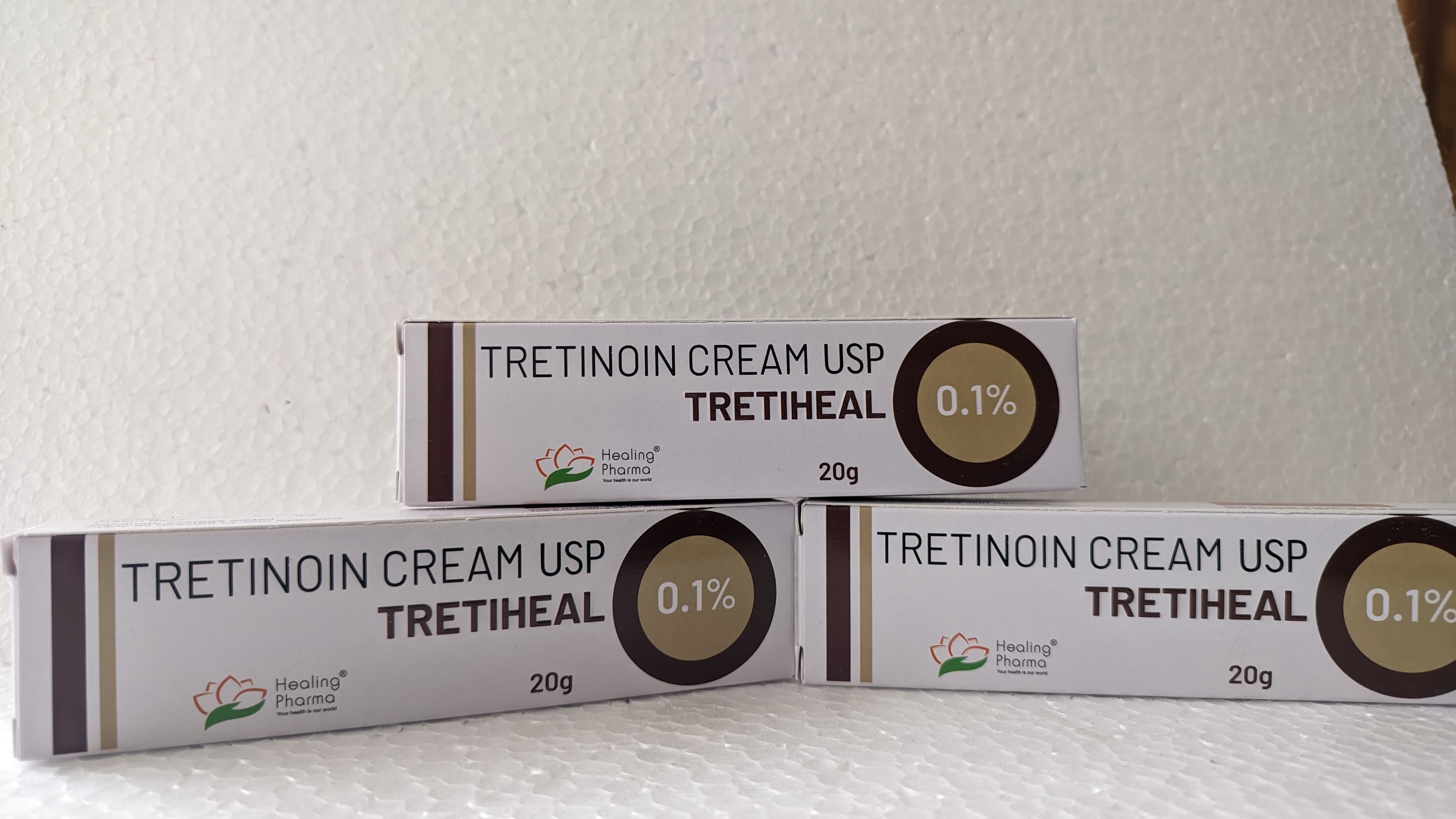 | TRETINOIN CREAM USP Tretiheal 0.1% Cream is a form of vitamin A that is used to treat acne which appears as spots or pimples on your face, chest, or back. View product → |
Frequently asked questions
Does Tretiheal 0.025 mean 0.025% or 0.25%?
0.025 normally means 0.025%, describing the tretinoin concentration in the cream rather than the tube size or package configuration.
How should buyers choose between Tretiheal 0.025% and 0.1%?
Choose the strength users can tolerate and apply consistently; a stronger formula is not useful if irritation prevents regular use.
What should users do before judging a Tretiheal cream’s results?
Set up application correctly, including the amount, frequency, skin preparation, and sun protection, before comparing results.
What should wholesalers check besides the tretinoin percentage?
Check the finished product’s label, tube, seal, batch number, expiry date, packaging, quality documents, and market-specific compliance records.
Related product
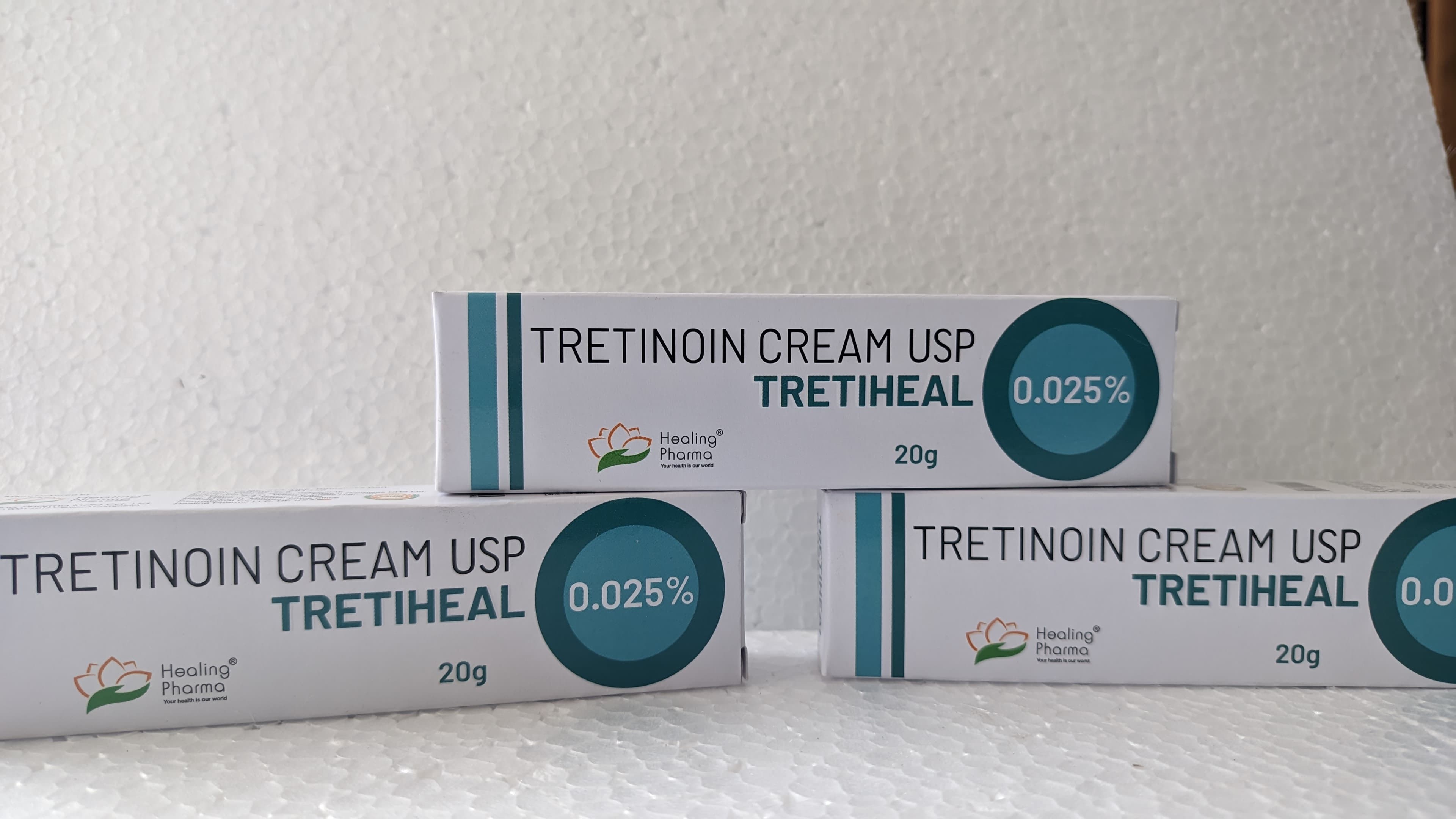 | TRETINOIN CREAM 0.025% Tretiheal Cream is a form of vitamin A that is used to treat acne which appears as spots or pimples on your face, chest, or back. View product → |