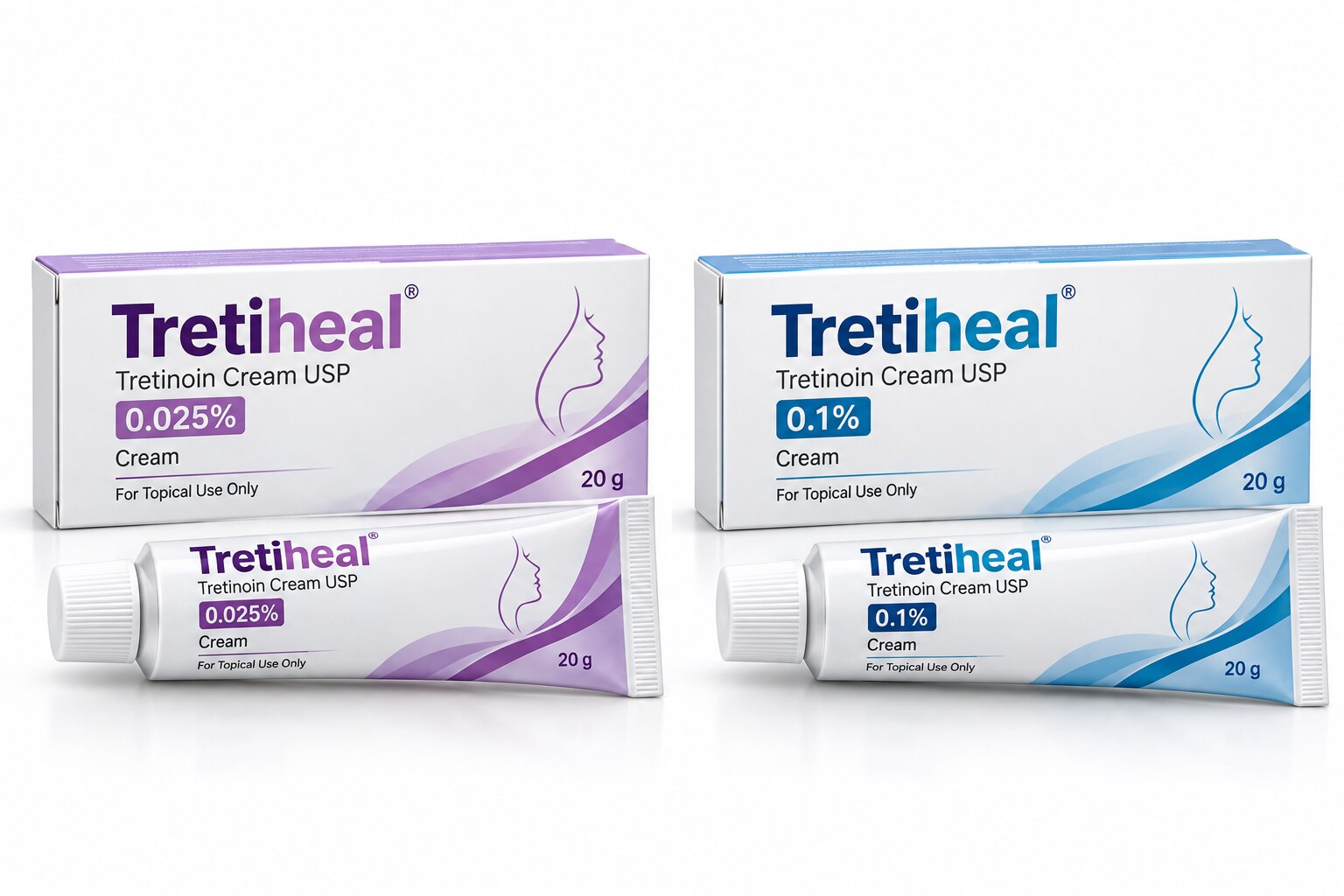
The choice between Tretiheal 0.025% and 0.1% is a trade-off between tretinoin exposure, irritation risk and the likelihood that you can use treatment consistently. By comparing the fourfold concentration difference, matching strength to skin tolerance and checking application and supply details, you can make a more informed product or treatment decision.
Key takeaways
- Tretiheal 0.1% is four times more concentrated than 0.025%.
- Start with the lower strength if your skin is sensitive or new to tretinoin.
- Apply a pea-sized amount at night and use sunscreen every morning.
- Verify the batch number, expiry date and supplier documents before ordering in Riyadh.
What the Fourfold Strength Difference Means for Your Skin
No. Tretiheal 0.1% is four times more concentrated than Tretiheal 0.025%, but that does not guarantee faster or better results. The trade-off is greater treatment intensity and a higher risk of redness, peeling, burning and dryness, which can make consistent use harder.
| Strength | Tretinoin per gram | Practical implication |
|---|---|---|
| Tretiheal 0.025% | 0.25 mg | Lower-intensity starting option; often easier for sensitive or retinoid-naive skin to tolerate |
| Tretiheal 0.05% | 0.5 mg | Intermediate step when 0.025% is tolerated but more intensity is needed |
| Tretiheal 0.1% | 1 mg | Highest concentration listed here; greater irritation risk without an automatic efficacy advantage |
The label percentage is not the whole comparison. The cream vehicle affects spreadability, occlusiveness, preservative exposure, stability and irritation, so compare the finished-product composition and specifications rather than assuming that every cream with the same percentage behaves identically. Actual exposure also changes with the amount applied and your skin condition.
A tretiheal 0.025 cream comparison should not treat tretinoin as interchangeable with retinol or retinaldehyde. Tretinoin is retinoic acid, while those cosmetic ingredients require conversion in the skin and follow different labelling and regulatory categories.
For acne, stronger is not always the correct next move. Nodules, moderate-to-severe inflammation or suspected scarring call for clinical assessment, because escalating concentration alone may not address the disease.
Which Tretiheal Strength Fits Sensitive, Acne-Prone or Retinoid-Tolerant Skin?
Choose 0.025% for sensitive or retinoid-naive skin, 0.05% for a tolerated intermediate step, and 0.1% only when your skin has already handled tretinoin without persistent irritation.
| Strength | Best fit | Main trade-off |
|---|---|---|
| 0.025% | Sensitive, dry, easily irritated or first-time users; mild acne | Lowest irritation burden, but progress may feel slower |
| 0.05% | Acne-prone skin needing more intensity after 0.025% is tolerated | More peeling, redness and dryness than 0.025% |
| 0.1% | Retinoid-tolerant skin with resilient, oily skin and a clear reason to intensify | Highest risk of burning, erythema, scaling and treatment abandonment |
The labelled concentration is substantial: 0.025% contains 0.25 mg of tretinoin per gram, 0.05% contains 0.5 mg, and 0.1% contains 1 mg. The 0.1% cream therefore has four times the nominal tretinoin concentration of 0.025%, not merely a small step up.
Match the choice to the acne pattern, not oiliness alone. Mild comedonal acne may suit a lower strength, while inflammatory lesions, nodules, scarring or moderate-to-severe acne call for medical assessment rather than automatic escalation.
If you have used prescription tretinoin consistently and tolerated it, 0.05% or 0.1% may fit. Retinol and retinaldehyde cosmetics are not equivalent substitutes for these Tretiheal cream strengths because they require conversion in the skin.
How to Apply Tretinoin Without Turning Irritation Into Treatment Failure
Use one pea-sized amount for the entire face, not one pea-sized dab per spot. Spread a thin film over acne-prone or photoaged skin in the evening, avoiding the eyelids, nostril creases and corners of the lips.
| Routine stage | Application | Purpose |
|---|---|---|
| First 2 weeks | Apply on two or three nonconsecutive nights each week | Lets your skin adjust |
| Next 2 weeks | Apply every other night if redness and peeling remain manageable | Builds regular exposure |
| After adjustment | Apply nightly only if your prescriber’s directions and your skin allow it | Maintains consistent treatment |
Wash gently, pat dry and wait until the skin is completely dry before applying tretinoin; applying it to damp skin increases stinging. More cream does not produce faster clearing or fading. It produces more irritation, which can force you to stop treatment.
- Do not scrub beforehand or combine tretinoin with abrasive cleansers, alcohol-heavy products, peeling acids or another topical retinoid.
- Separate benzoyl peroxide from tretinoin when the finished-product label or pharmacist instructs you to do so.
- Keep tretinoin away from broken, sunburned or eczematous skin.
- Use broad-spectrum sunscreen each morning and limit unnecessary ultraviolet exposure, especially in Riyadh.
- Discuss pregnancy before use; topical tretinoin is generally avoided during pregnancy because safety evidence remains limited.
If burning, swelling or severe dermatitis develops, stop applying it and contact a clinician rather than increasing the interval or adding more products.
What Reactions and Timelines Should You Expect During Treatment?
Dryness, mild peeling, tightness, redness and brief stinging are common during the first two to four weeks, especially with 0.1% cream. They indicate irritation, not faster treatment; applying more cream can turn manageable dryness into dermatitis.
| Reaction | Usual timing | What it means |
|---|---|---|
| Mild tightness or flaking | Days 3–14 | Reduce frequency and moisturise |
| Light redness or brief stinging | After application | Acceptable if it settles quickly |
| Temporary acne worsening | Weeks 2–6 | Early adjustment can precede improvement |
| Meaningful acne improvement | About 6–12 weeks | Continue consistently before judging strength |
Early breakouts do not automatically mean treatment failure. Contact a clinician if acne becomes painful and rapidly worse, or if irritation persists despite reducing applications. Stop and seek prompt medical advice for facial swelling, hives, blistering, severe burning, marked swelling around the eyes, or oozing and crusting.
Use a gentle, fragrance-free, non-comedogenic moisturiser to protect the skin barrier. Apply it after tretinoin, or before and after tretinoin if dryness makes treatment difficult; do not use moisturiser as a reason to apply extra cream.
Apply broad-spectrum sunscreen with SPF 30 or higher every morning, and limit unnecessary midday ultraviolet exposure. Riyadh’s intense sun can worsen redness and dark marks, while tretinoin increases sensitivity. Sunscreen supports tolerability but does not replace a thin, pea-sized evening application or justify moving up to 0.1% before your skin has adapted.
What Riyadh Buyers Should Verify Before Ordering Tretiheal Cream
A fourfold concentration difference is not the only purchasing variable in the tretiheal 0 point 025 cream versus 0 point 1 cream in riyadh decision. Compare the finished cream’s excipients, spreadability, occlusiveness, preservative system, stability data and irritation profile, not just the percentage printed on the carton.
Use this ordering procedure:
1. Specify “tretinoin cream 0.025%,” the required pack size, dosage form, language, minimum remaining shelf life and destination. “tretiheal 0 point 025 wholesale” alone leaves the batch, market and commercial status unclear.
2. Request the exact product registration details and confirm Saudi Food and Drug Authority (SFDA) registration for the intended strength, manufacturer and dosage form. A marketplace listing does not prove authorisation for Saudi distribution.
3. Obtain the certificate of analysis showing assay, plus the batch number, manufacturing date and expiry date. Match these details across the certificate, invoice, outer carton and tube.
4. Inspect tamper evidence, seal integrity and packaging artwork. Ask for storage requirements and records of temperature excursions during transport; do not accept “stored correctly” without supporting documentation.
5. Confirm that product information covers pharmacist counselling, including pregnancy avoidance wording. Do not substitute retinol or retinaldehyde cosmetics for tretinoin, which is the active retinoic-acid medicine.
NIBA HEALTHCARE can be evaluated as a tretinoin cream supplier in riyadh using the same document-and-batch checks. For moderate or nodulocystic acne, suspected scarring, or extensive inflammatory lesions, verify the buyer’s clinical pathway rather than ordering 0.1% as an automatic escalation.
Frequently asked questions
Is Tretiheal 0.1% four times stronger than 0.025%?
Yes. Tretiheal 0.1% contains four times the tretinoin concentration of 0.025%, but it does not guarantee faster results.
Which Tretiheal strength suits sensitive or acne-prone skin?
The 0.025% cream is the more cautious starting option for sensitive skin or people new to tretinoin. A clinician can advise whether acne severity warrants another strength.
How should you apply Tretiheal cream to reduce irritation?
Apply a pea-sized amount to completely dry skin at night, avoid the eyes and lips, moisturise, and use broad-spectrum sunscreen each morning.
What reactions and treatment timelines should you expect?
Redness, dryness, peeling and burning can occur, especially after increasing strength. Persistent or severe reactions require medical advice, and visible improvement takes consistent use over time.
What should Riyadh buyers verify before ordering Tretiheal cream?
Check the exact strength, batch number, expiry date, sealed packaging, storage instructions and the supplier’s licensing and product documents before ordering.