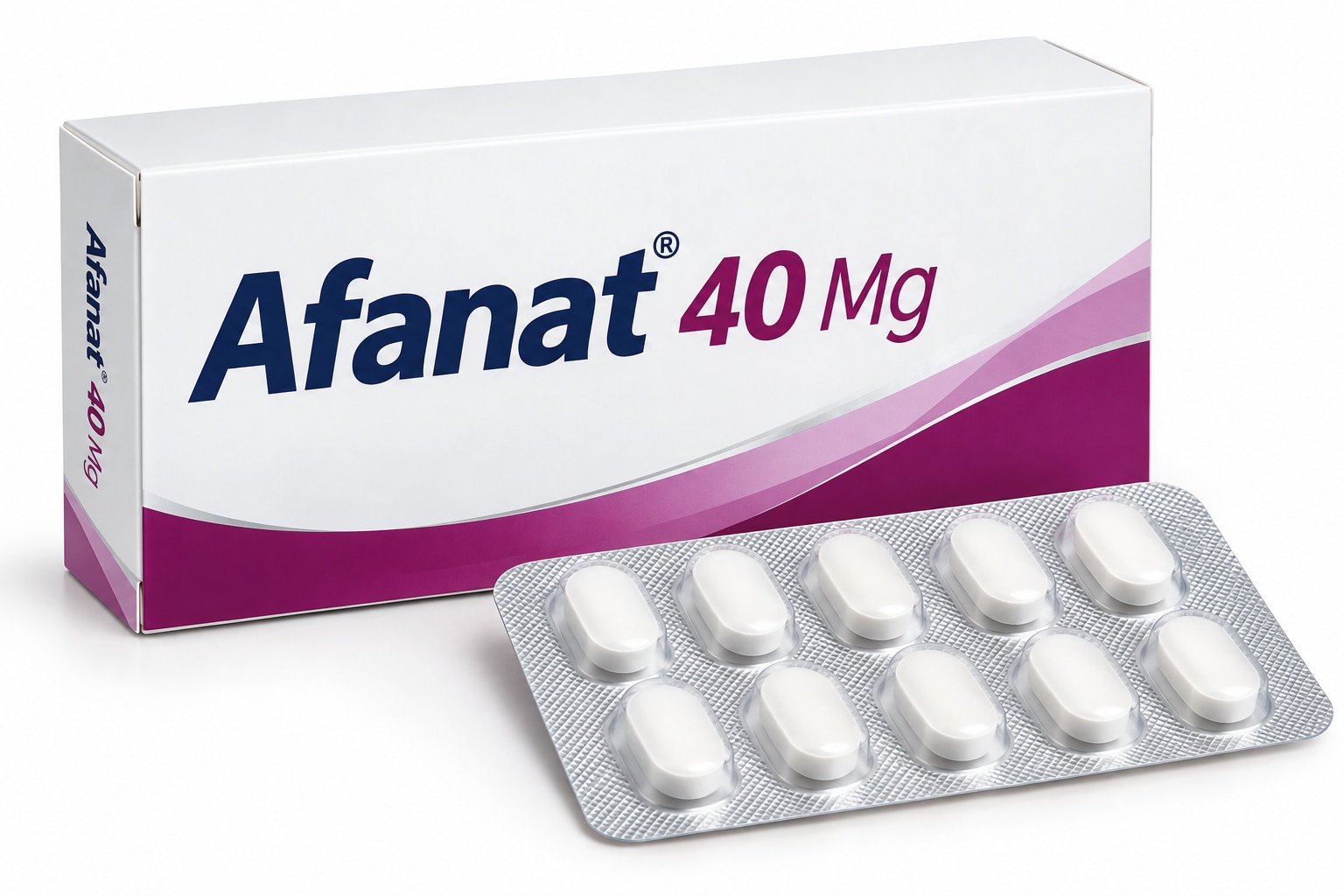
A hospital cannot choose an Afanat 40 mg exporter safely from a brand name, strength and tablet price alone. By the end, procurement teams will be able to verify the medicine, qualify an afatinib exporter, compare delivered offers, and decide whether an overseas supplier fits their regulatory, clinical and operational needs.
Key takeaways
- Confirm afatinib, salt, dosage form and legal status before comparing prices.
- Request the manufacturer licence, batch certificate and traceability documents.
- Check pack details, temperature controls, lead time and Incoterms in writing.
- Pilot one shipment before approving repeat hospital supply.
Confirm what Afanat 40 mg is before comparing suppliers
Do not compare prices until you have proved that the offered product is the medicine your formulary team intends to review. “Afanat 40 mg” is only a brand-and-strength claim; it does not establish the ingredient, salt, dosage form or legal status in your country.
1. Match the product identity across the quotation, carton, blister and certificate of analysis. Each should state afatinib as the active ingredient, the exact salt form, 40 mg strength, tablet dosage form and marketing authorisation holder. Reject mismatched names, missing batch details or a carton that identifies only Afanat.
2. Ask the afatinib 40mg supplier for the destination country’s registration or marketing authorisation evidence, import-permit requirements and prescription status. An Indian manufacturing or export licence does not prove that the product is legally importable or approved where your hospital operates.
3. Request the approved product specification and evidence accepted by the destination regulator for pharmaceutical equivalence and bioequivalence, or the applicable alternative approval route. Do not treat two 40 mg tablets as clinically interchangeable without that evidence.
4. Check the approved label before formulary review. Afatinib is taken once daily on an empty stomach: at least one hour before or two hours after food. Review P-glycoprotein inhibitor interactions, dose-adjustment guidance and support for diarrhoea, rash, stomatitis and paronychia.
If the supplier cannot provide these records before evaluation, place the offer on hold rather than treating the brand name as proof of suitability.
Qualify the exporter through regulatory and batch evidence
A legally importable afatinib exporter can prove both market access and batch identity. An Indian manufacturing licence or export licence alone is insufficient: the hospital must verify registration or marketing authorisation in the destination country, plus any import permit and prescription requirements.
| Evidence | What to verify | Warning sign |
|---|---|---|
| Destination approval | Marketing authorisation number, approved product name, strength, dosage form and marketing authorisation holder | The seller provides only a brand name or Indian licence |
| Manufacturing site | Current WHO-GMP certificate for the actual tablet site and dosage form | The certificate names a different facility, expired site or unrelated product category |
| Product file | Approved specification, pharmaceutical-equivalence and bioequivalence or other regulator-accepted approval evidence | “40 mg” is treated as proof of interchangeability |
| Batch file | Certificate of analysis, batch release record, batch manufacturing and packaging records, batch number and expiry | A generic sample CoA has no matching batch number |
| Stability evidence | Stability data supporting the stated shelf life and storage conditions | No shelf-life basis or no remaining-shelf-life commitment |
Request these documents before purchase:
- Certificate of Pharmaceutical Product, where the destination authority requires it
- Current GMP certificate and manufacturing licence naming the production site
- Product specification stating afatinib, exact salt form, 40 mg strength and tablet dosage form
- Batch-specific CoA showing assay, dissolution, impurities and microbiological results
- Release authorisation signed by the responsible quality unit
Retain the documents in the afatinib hospital procurement file. Reject the offer if the exporter cannot connect the carton, blister and CoA to the same approved manufacturer and batch, or cannot show that the destination authority permits import.
Inspect the quotation, pack and shipment conditions
Do not accept the lowest tablet price until you convert every offer into delivered cost per usable tablet. An afanat 40mg pharmaceutical exporter should state stock status, production lead time, minimum order quantity, payment terms, Incoterm, freight responsibility, insurance and the expiry period guaranteed at dispatch.
| Detail | Acceptable offer | Warning sign |
|---|---|---|
| Manufacturer and site | Named legal manufacturer, manufacturing address and marketing authorisation holder | Trading company name only |
| Product identity | Afatinib, exact salt form, 40 mg tablet, pack size and authorised brand shown on quotation, carton and blister | Brand name without active ingredient or dosage details |
| Shelf life | Written minimum remaining shelf life at shipment, with batch and expiry supplied before approval | “Fresh stock” without a percentage or date commitment |
| Documents | Certificate of analysis, product specification, batch-release evidence and stability information | CoA promised only after payment |
| Packaging | Intact, moisture-protective primary blisters, sealed cartons, batch number and expiry legible | Loose tablets, damaged seals or mixed batches |
| Transport | Validated or justified conditions, tracking, insurance and a written excursion procedure | Reliance on the carton’s storage statement alone |
Compare the afatinib 40mg supplier’s quote on that common basis: product cost, freight, customs charges, testing, local clearance and unusable short-dated stock. Ask who replaces goods damaged by moisture, crushed blisters or a temperature excursion.
Before issuing a purchase order, match the quoted pack and batch to the destination market’s registration or legal import route. A cheaper offer is not cheaper if the pack cannot clear customs or the remaining shelf life fails your hospital’s release policy.
Run a documented hospital procurement workflow
Move from quotation to release through controlled hand-offs, with one owner and one record for each decision. That prevents a low-priced offer from becoming an unimportable shipment or an unreleasable batch.
1. Procurement and pharmacy confirm the quotation against the formulary: afatinib, exact salt form, 40 mg strength, tablet dosage form, marketing authorisation holder and approved product specification. Record the afatinib exporter’s manufacturer, site, pack size, price delivered to destination, remaining shelf-life commitment and lead time.
2. Regulatory affairs verifies destination-country registration or legal importability, import permit requirements and prescription controls before approval. Add the certificate of pharmaceutical product, GMP evidence, batch-specific certificate of analysis, product specification and stability evidence to the procurement file.
3. Issue the purchase order only after finance, pharmacy, regulatory and quality sign-off. State the accepted pack, quantity, batch documentation, minimum remaining shelf life, storage conditions, shipping responsibility and rejection rights for damage, temperature excursion or missing records.
4. Before dispatch, match the commercial invoice, packing list, airway bill and import permit to the purchase order. The customs broker submits the required import-clearance file and escalates any mismatch before delivery.
5. Receive cartons into quarantine, not available stock. Warehouse staff record seal condition, carton and blister details, batch number, manufacturing and expiry dates, quantity, storage temperature and any transit excursion.
6. Quality assurance reconciles the shipment with the approved specification and COA, investigates discrepancies and authorises written release. Pharmacy receives the stock only after that release; retain the full traceability file for recalls and audits.
Test repeat supply, safety support and the case for an overseas exporter
An overseas afatinib exporter is a workable long-term option only when repeat orders are more predictable than the risks of importing them. Compare cost per usable tablet delivered, including freight, clearance, testing, documentation and the required remaining shelf life—not the ex-works tablet price.
| Option | Evidence to verify | Decision |
|---|---|---|
| Repeat supply | Confirm production lead time, minimum order quantity, batch size, expiry at shipment and written remaining-shelf-life commitment | Accept for planned replenishment when two or more orders can be supported |
| Urgent requirement | Confirm stock is physically available, dispatch date and transit route; calculate whether import clearance fits the treatment date | Reject if treatment depends on an unconfirmed production slot or slow clearance |
| Registration | Verify destination-market registration or lawful import permission, prescription rules and any import permit before ordering | Reject if the product is legal only in the exporter’s country |
| Safety support | Require the approved product specification, dose-modification guidance, counselling material and a named contact for quality complaints | Reject if the supplier provides tablets but no safety or pharmacovigilance pathway |
Afatinib hospital procurement must also preserve the empty-stomach instruction: take it at least one hour before or two hours after food. Your protocol needs a response for diarrhoea, rash or acneiform dermatitis, stomatitis and paronychia; a low price does not compensate for unmanaged toxicity.
If NIBA HEALTHCARE is assessed as an Afanat 40mg pharmaceutical exporter, ask for a stock statement, batch documents, destination-market importability evidence and a written repeat-supply plan. That test separates a usable partner from a one-off quotation.
Related product
 | AFATINIB Afanat 40 Tablet is used in the treatment of non-small cell lung cancer. View product → |
Frequently asked questions
What should a hospital confirm before comparing Afanat 40 mg exporters?
Confirm that the offered medicine contains the intended active ingredient, afatinib, in the correct salt, 40 mg strength and dosage form, then verify its legal status in the destination country.
Which documents help qualify an Afatinib exporter?
Ask for identifiable manufacturer and exporter details, the applicable manufacturing licence, product registration evidence, batch documentation and records that link the supplied packs to the stated batch.
What shipment details should appear in an Afanat 40 mg quotation?
The quotation should identify the product and pack, quantity, price basis, lead time, expiry expectations, transport conditions, temperature controls, shipping documents and agreed Incoterms.
How can a hospital test whether an overseas Afatinib supplier is reliable?
Use a documented pilot order, inspect the delivered packs and records, log deviations, confirm safety-support contacts and measure repeat-order performance before approving routine supply.