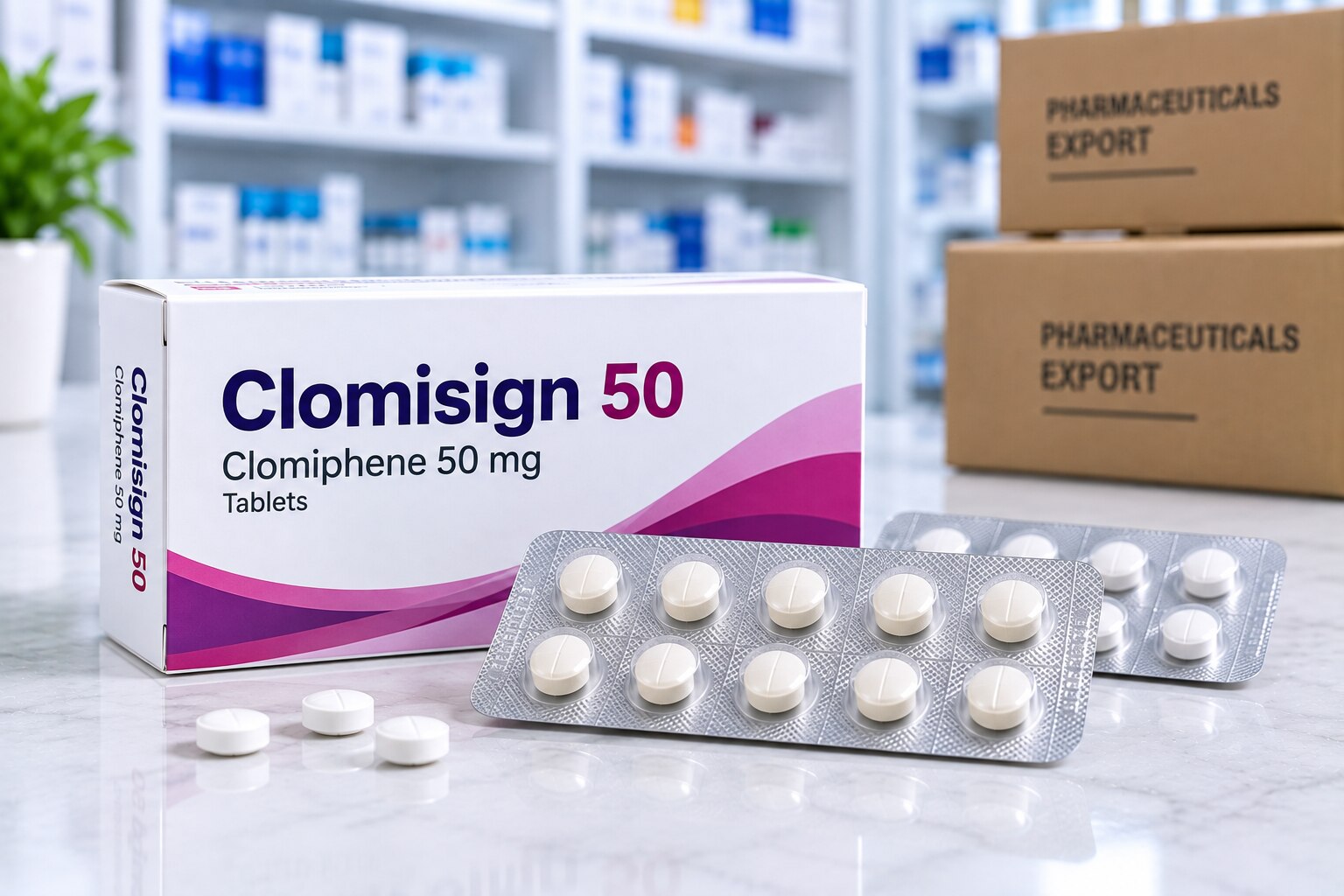
A safe purchase starts by confirming that Clomisign 50 is clomifene citrate 50 mg, then checking whether a clinician has identified ovulatory dysfunction and whether the product is authorized for import and sale in Peru. You will be able to evaluate the treatment, identify a lawful supply chain, and compare a wholesale quotation without treating a fertility medicine like an ordinary supplement.
Key takeaways
- Confirm ovulatory infertility before considering clomifene citrate 50 mg.
- Rule out pregnancy, ovarian cysts, liver disease, and uncontrolled thyroid disorders.
- Monitor follicles and stop treatment if ovarian hyperstimulation or visual symptoms develop.
- Ask for DIGEMID registration, batch records, a certificate of analysis, and importer details.
Is clomifene citrate 50 mg appropriate for the patient?
Clomifene citrate stimulates ovulation by blocking oestrogen receptors in the hypothalamus. The brain then detects too little oestrogen, releases more gonadotrophin-releasing hormone, and prompts the pituitary to produce follicle-stimulating hormone and luteinising hormone. These hormones support follicle growth and trigger ovulation.
A 50 mg tablet is usually the starting strength for an appropriately evaluated patient with ovulatory dysfunction, after pregnancy has been excluded and a clinician has assessed the menstrual pattern and ovarian response. Treatment is commonly prescribed for five days early in the menstrual cycle, but the start date belongs to the prescriber.
Do not increase the dose because ovulation has not occurred in one cycle.
Clomifene is not a general fertility supplement and will not correct every cause of infertility. A clinician must investigate whether the main problem is:
- Anovulation, including ovulatory dysfunction associated with polycystic ovary syndrome
- Blocked fallopian tubes, which clomifene cannot bypass
- Diminished ovarian reserve or severe male-factor infertility, where another strategy may be needed
- Unexplained infertility, where empiric treatment requires specialist judgment
Do not use clomifene during pregnancy. Liver disease, unexplained abnormal uterine bleeding, uncontrolled thyroid or adrenal disease, or an ovarian cyst unrelated to polycystic ovary syndrome require medical review before treatment. A search for “clomifene citrate exporter peru” concerns procurement; it does not prove that 50 mg is suitable for a particular patient.
What must a clinician rule out before prescribing it?
Before prescribing, confirm that the patient’s infertility results from ovulatory dysfunction that clomifene can address. A 50 mg tablet will not correct blocked tubes, severe male-factor infertility, diminished ovarian reserve, or every case of unexplained infertility.
| Cause or finding | Why clomifene is unsuitable or insufficient | Required action |
|---|---|---|
| Tubal blockage | Ovulation will not overcome an obstructed fallopian tube | Assess tubal patency |
| Severe male-factor infertility | More ovulation does not correct severely impaired sperm production or delivery | Obtain semen analysis and refer for appropriate treatment |
| Diminished ovarian reserve | Ovarian stimulation may offer little benefit and needs a different fertility plan | Check ovarian reserve and specialist advice |
| Unexplained infertility | The benefit is not assumed without a complete fertility assessment | Review both partners before prescribing |
| Anovulation with PCOS | This may be an appropriate indication, but other causes must be excluded | Confirm the diagnosis and treatment plan |
Do not prescribe during pregnancy. Exclude liver disease or previous liver dysfunction, unexplained abnormal uterine bleeding, uncontrolled thyroid or adrenal disease, and an ovarian cyst not caused by polycystic ovary syndrome.
Stop self-directed dosing and arrange medical review for severe abdominal or pelvic pain, abdominal swelling, rapid weight gain, or breathing difficulty; these signs can indicate ovarian enlargement or hyperstimulation. New visual symptoms also require prompt assessment, because continuing treatment can worsen a potentially persistent problem.
How is a supervised clomifene treatment cycle managed?
Treatment usually begins early in the menstrual cycle, often on day 2, 3, 4, or 5, after the clinician confirms that the patient is not pregnant. The common regimen is clomifene 50 mg once daily for five consecutive days, with ovulation often occurring 5 to 10 days after the final tablet.
A supervised cycle follows this sequence:
- Take only the prescribed five-day course. The clinician assesses ovulation with a mid-luteal serum progesterone test, ovulation-predictor testing, or transvaginal ultrasound.
- If ovulation does not occur, the clinician reviews the results and adverse effects before changing the dose for a later cycle. Never add tablets or repeat treatment early; usual labeling limits treatment to three courses.
- Ultrasound can show follicle development, excessive ovarian response, and the risk of multiple gestation. The FDA label reports about 8% twin pregnancies among reported clinical-study pregnancies.
- If menstruation is late, take a pregnancy test before another course. Stop clomifene and contact the prescriber after a positive result because clomifene is not used during pregnancy.
- Report blurred vision, flashes, spots, severe pelvic pain, or abdominal swelling promptly.
The full cycle lasts from the first treatment day until the next period or confirmed pregnancy, so its calendar length varies. A clinician decides whether another cycle is safe and appropriate; self-adjustment bypasses both pregnancy and multiple-gestation monitoring.
How do you verify a lawful Clomisign 50 supply in Peru?
A lawful supply starts with two matches: Clomisign 50 must appear in DIGEMID’s official pharmaceutical-product database, and the proposed Peruvian importer must hold the authorization required to import and distribute medicines. An Indian GMP certificate or export licence alone does not permit commercial sale in Peru.
Ask the Clomisign 50 supplier in Lima for these records before paying:
- The approved Peruvian sanitary-registration number, registration holder, and DIGEMID database entry
- A Spanish-language label or approved artwork showing clomifene citrate, 50 mg, tablet dosage form, manufacturer, batch number, expiry date, and storage instructions
- The batch certificate of analysis, with assay, dissolution, identification, and release results
- The manufacturer’s licence, GMP evidence, batch-release certificate, and certificate of origin
- The Peruvian importer’s establishment authorization and tax identity, plus the name of the importer of record
- VUCE import documentation or the specific sanitary authorization used for the shipment
Check that “clomifene citrate” on the Peruvian registration corresponds to “clomiphene citrate” on English export papers; these names describe the same active ingredient, but the authority-approved denomination controls the local label. NIBA HEALTHCARE, or any exporter you contact, should state whether it is the manufacturer, exporter, or only a trading intermediary.
If you want to buy clomisign 50 in lima, confirm who holds the DIGEMID registration, who files the VUCE entry, who clears customs, and who handles Spanish labelling, recalls, and pharmacovigilance. Do not treat a quotation from India as proof of a legally deliverable Peruvian product.
Related product
 | Clomifene Citrate 50mg Tablets Clomisign 50 Tablet is a medicine used to treat female infertility. View product → |
What should a Lima wholesale buyer demand before placing an order?
Reject any clomisign wholesale in lima quotation that gives only a unit price. Compare the commercial offer with the legally deliverable supply:
| Item | Export quotation | Peru-ready wholesale offer |
|---|---|---|
| Seller and route | Indian exporter named | Exporter, Peruvian importer of record and DIGEMID registration holder named |
| Delivery | Incoterm and freight point stated | Customs, VUCE filing and sanitary clearance responsibilities assigned |
| Product | “Clomisign 50” shown | Label confirms clomifene citrate 50 mg tablets and Peruvian registration number |
| Supply | Minimum order and expiry stated | Remaining shelf life at dispatch guaranteed in writing |
| Storage | Temperature and humidity stated | Transport controls, data logger and receiving procedure specified |
Before payment, ask the proposed clomifene tablets distributor peru for these records:
- Actual batch number, product label, manufacturing licence and GMP evidence.
- Certificate of analysis matching that batch, including identification, assay, tablet uniformity, dissolution and related substances.
- Packaging-integrity evidence and microbiological results where the specification requires them.
- Recall contact, pharmacovigilance contact and the party responsible for Spanish-language labelling.
- Written allocation of damage, temperature excursion, customs rejection and short-shelf-life claims.
Check the product and importer in DIGEMID’s official pharmaceutical-product database. An Indian GMP certificate or export licence does not authorise commercial sale in Peru. Confirm who clears the shipment before signing the purchase order.
Frequently asked questions
Is clomifene citrate 50 mg appropriate for every patient?
No. A fertility clinician must confirm the cause of infertility and ovulatory status. Clomifene is not appropriate for pregnancy, unexplained abnormal uterine bleeding, uncontrolled thyroid or adrenal disease, liver disease, ovarian cysts unrelated to polycystic ovary syndrome, or clomifene hypersensitivity.
What must a clinician rule out before prescribing Clomisign 50?
The clinician should rule out pregnancy, menopause when relevant, tubal or uterine factors, severe male-factor infertility, liver disease, uncontrolled thyroid or adrenal disorders, ovarian cysts, and abnormal uterine bleeding. Baseline assessment can include pregnancy testing, pelvic examination, ovarian reserve or hormone testing, and semen analysis.
How is a supervised clomifene treatment cycle managed?
A clinician selects the dose and cycle day, confirms that ovulation occurred, and limits repeated cycles according to the patient’s response and local prescribing guidance. Ultrasound monitoring helps assess follicle development and multiple-gestation risk. Stop treatment and seek urgent review for severe pelvic pain, abdominal swelling, breathing difficulty, or visual disturbances.
How do you verify a lawful Clomisign 50 supply in Peru?
Check the product’s current DIGEMID Registro Sanitario status, the authorised importer or distributor, Spanish labelling, active ingredient and strength, batch number, expiry date, tamper-evident seal, and storage instructions. Match the shipment to its invoice and transport records, and reject packs with altered labels or missing traceability.
What should a Lima wholesale buyer demand before placing an order?
Request the exporter’s manufacturing and export documents, product specification, certificate of analysis for the batch, certificate of pharmaceutical product when required, packing list, invoice, batch and expiry details, storage and transport conditions, and the Peruvian importer’s licence and DIGEMID documentation. Confirm that the documents identify clomifene citrate 50 mg tablets and the exact manufacturer.